LoonieWallet Team · Mortgage · Last verified
Fixed vs Variable Mortgage in Canada: How to Compare the Risk, Not Predict the Rate
A five-year fixed costs more than a variable today. Whether it is worth it depends on how much a rate rise would hurt you, not on a forecast. Three rate paths, the short-fixed alternative most borrowers are now choosing, trigger rates, and the penalty gap, all with numbers.
On 2026-09-17 the lowest advertised five-year variable rate was 3.30%, the lowest insured five-year fixed 4.24%, and the lowest three-year fixed 4.19%. The Bank of Canada had just held its policy rate at 2.25% for the seventh straight decision while warning that “the upside risks to inflation have increased.” Forecasters disagree about what comes next, and they disagreed a year ago too.
So this guide does not forecast. It shows what each choice costs under three rate paths, what a rate rise does to your payment, what breaking each mortgage costs, and which questions decide it for you.
What the terms mean
The FCAC’s definitions are the ones lenders use:
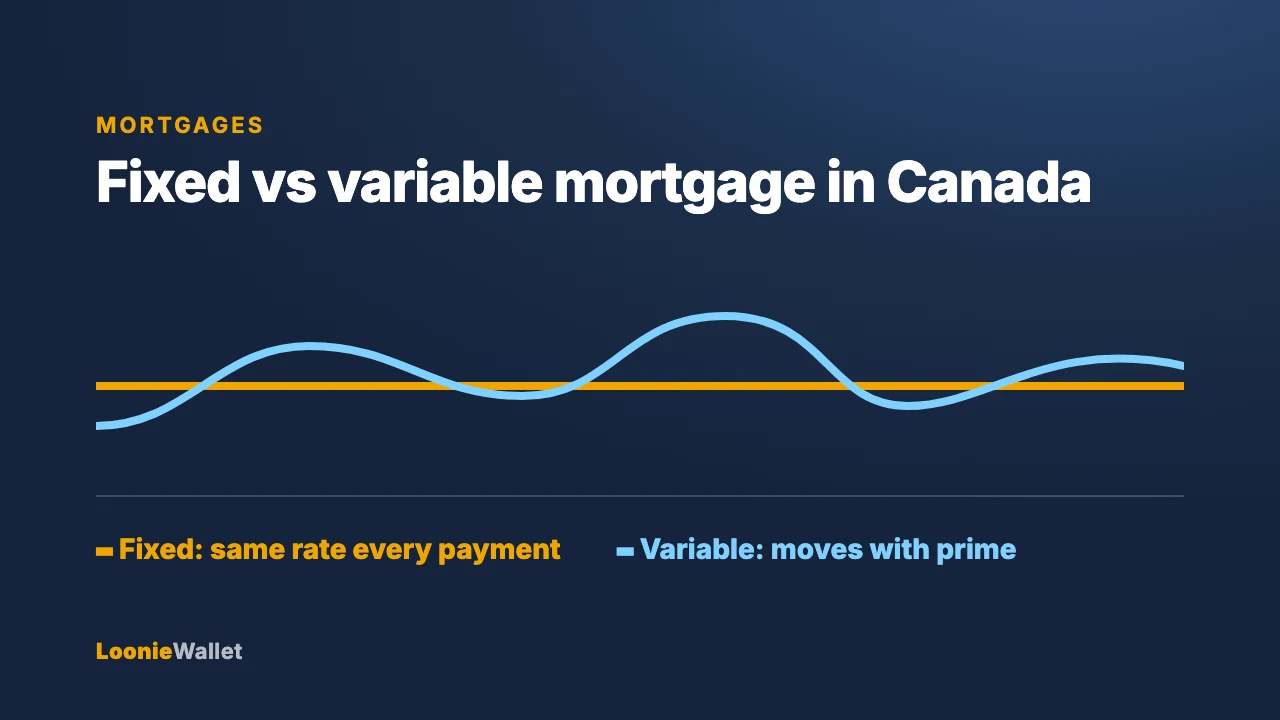
- Fixed rate: the rate and payment stay the same for the whole term. Usually higher than a variable rate for the same term.
- Variable rate: the rate moves with your lender’s prime rate, which follows the Bank of Canada’s policy rate. Typically lower than fixed at the outset.
- Variable with adjustable payments: your payment changes when the rate changes, so your amortization stays on schedule.
- Variable with fixed payments: your payment stays the same and the split between interest and principal shifts. If rates rise enough, the payment no longer covers the interest (the “trigger rate”) and the balance can grow, which the FCAC calls negative amortization.
- Open vs closed: open mortgages can be paid off any time without penalty but carry higher rates; closed mortgages have lower rates and limited prepayment privileges.
Most Canadian mortgages are closed, and most variable mortgages at the big banks have fixed payments unless you ask otherwise. Ask.
Three rate paths, one $400,000 mortgage
The table uses a $400,000 balance, 20 years of amortization, and the rates above. The variable paths move the rate a quarter point every six months for two years and then hold; the “flat” path never changes. Interest is totalled over the five-year term, and Canadian fixed mortgages compound semi-annually, which the figures reflect.
| Option | Starting payment | Payment at end of term | Interest paid over 5 years | Versus 5-year fixed |
|---|---|---|---|---|
| 5-year fixed at 4.24% | $2,467 | $2,467 | $76,982 | — |
| Variable at 3.30%, rates flat | $2,274 | $2,274 | $59,523 | $17,458 less |
| Variable, rates rise 1.00% over two years | $2,274 | $2,468 | $73,006 | $3,975 less |
| Variable, rates fall 1.00% over two years | $2,274 | $2,089 | $46,162 | $30,820 less |
| 3-year fixed at 4.19%, then 2 years at 3.24% | $2,458 | $2,317 | $69,521 | $7,460 less |
| 3-year fixed at 4.19%, then 2 years at 4.24% | $2,458 | $2,458 | $76,392 | $589 less |
| 3-year fixed at 4.19%, then 2 years at 5.24% | $2,458 | $2,599 | $83,277 | $6,296 more |
Two conclusions. First, the variable starts far enough below the fixed that it still wins if rates rise a full point over two years; on these numbers the variable rate has to rise between 1.25 and 1.5 points early in the term before the fixed costs less. Second, the three-year fixed is a bet on the renewal rate two years out, and its result lands within a few thousand dollars of the five-year fixed unless renewal rates move a full point.
These are the outcomes of three arbitrary paths. The point is the shape: the variable’s advantage is front-loaded, and the fixed’s cost is the price of not caring which path happens.
What a rate rise does to a variable payment
With adjustable payments, each 0.25% rise on a $400,000 balance adds about $50 a month. A full point adds about $195. If that would strain your budget, the fixed premium of roughly $193 a month in the table above is the insurance you are buying, and it is fairly priced against a one-point rise.
With fixed payments, the payment stays at $2,274 while the rate rises. On this mortgage the trigger rate, where $2,274 covers only interest, is about 6.8%. That is 3.5 points above today’s variable rate, so it is remote on the current numbers, but borrowers who took fixed-payment variables in 2021 at 1.5% hit theirs in 2022 and 2023. If you take a fixed-payment variable, know your trigger rate on day one; your lender must tell you.
The short-fixed option most borrowers are choosing
The five-year fixed is no longer the default. CMHC reports that in February 2026, variable rates were the most popular choice at chartered banks at 42% of extended mortgages, three-to-under-five-year fixed terms took 35%, and the five-year fixed only 11%.
A three-year fixed gives a fixed payment with a renewal sooner. It suits people who want certainty but expect rates to be lower in three years, or who may sell or move around then and want a smaller penalty exposure. It is a worse choice than the five-year fixed if rates rise by renewal, as the table shows. It is also a worse choice than the variable if rates fall, because you cannot benefit until the term ends.
Breaking the mortgage: the penalty gap
If there is any real chance you sell, refinance, or move in the next five years, this section may matter more than the rate.
- Variable: the penalty is usually three months’ interest. On $400,000 at 3.30% that is about $3,300.
- Fixed: the greater of three months’ interest or the interest rate differential (IRD). Three months’ interest at 4.24% is about $4,240. The IRD applies when your rate is above the lender’s current rate for your remaining term and, in the FCAC’s words, you signed the contract less than five years ago. With three years left and a comparison rate one point lower, a contract-rate IRD is about $12,000. Big banks typically calculate the IRD from their posted rates less your original discount, which can produce a comparison rate far below the market rate and a penalty of $18,000 or more on the same mortgage.
Lenders must disclose their method in a prepayment box in your mortgage documents. If you choose fixed, read that box before you choose the lender, and prefer a lender that uses contract rates. Portability, which lets you move the mortgage to a new home, can avoid the penalty entirely and is worth more on a fixed mortgage than on a variable one.
Most variable mortgages can be converted to a fixed term at any time without penalty, at the lender’s fixed rate that day. That option has value, but it is not free insurance: by the time you want to lock in, fixed rates have usually already risen.
Three questions that decide it
- If your payment rose by $200 a month within two years, would it hurt? If yes, take the fixed. The premium is small relative to that risk. If no, the variable’s expected cost is lower.
- Might you sell, refinance, or move before the term ends? If yes, the variable’s three-months’-interest penalty, or a shorter fixed term, protects you from the IRD.
- Would you actually convert a variable to a fixed if rates started rising? If you know you would panic and lock in after the first increase, you will pay the variable’s early risk and then the fixed’s higher rate. Take the fixed from the start.
Answer all three honestly and the choice usually makes itself. The forecast never enters into it.
Where this fits
Renewing rather than buying? The same choice applies, and CMHC’s data shows most renewers are taking variable or short fixed terms. The mortgage renewal checklist covers when you can switch lenders without requalifying and what a switch costs. To see any of the payments above at your own balance and rate, use the renewal calculator.
Rates on this page are observations from 2026-09-17 and change weekly. This article is for education, not mortgage advice; your lender’s terms, penalty method, and your own budget decide the right choice.
About LoonieWallet
LoonieWallet is an independent resource created to help make smarter financial decisions. We research and publish fact-based guides, tutorials, and product reviews covering money transfers, fintech apps, and personal finance tools. Our mission is to make personal finance easier and clearer so readers can save time, money, and stress.
Read more about us here. If you have any questions, you can contact us using this page.
Sources
Checked on Sep 18, 2026 (FCAC definitions of fixed, variable, open and closed mortgages and payment types; FCAC prepayment penalty methods; CMHC term-choice data; rate observations).
- Choosing a mortgage — Financial Consumer Agency of Canada
- Mortgage fees: prepayment penalties — Financial Consumer Agency of Canada
- Residential Mortgage Industry Report, Spring 2026 — Canada Mortgage and Housing Corporation
- Bank of Canada maintains the policy rate at 2¼% (September 2, 2026) — Bank of Canada
- Best 5-year fixed, 5-year variable and 3-year fixed rates (observed September 17, 2026) — Ratehub.ca