LoonieWallet Team · Investment · Last verified
TFSA vs FHSA: Which Should a First-Time Home Buyer Use First?
Both grow tax-free and both come out tax-free for a home. Only one gives you a deduction on the way in. Here is the math on FHSA first, when the TFSA still wins, and how to move existing TFSA savings across without losing room.
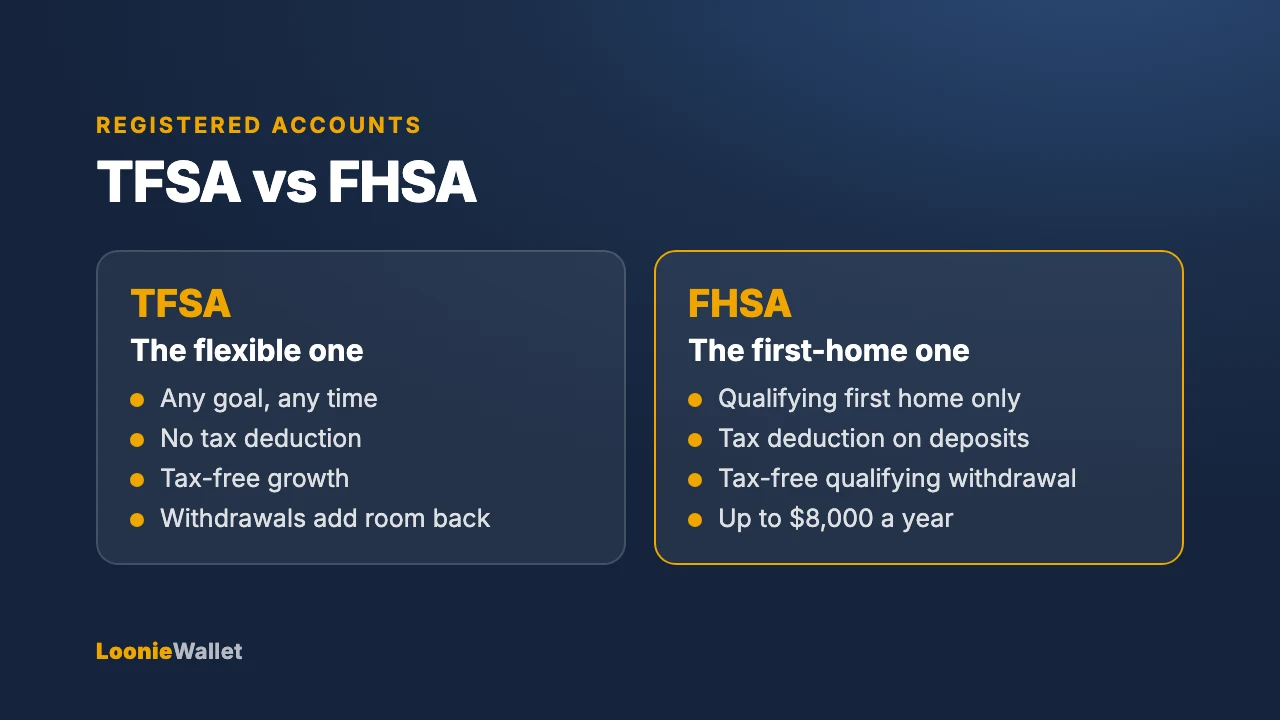
If you qualify for a First Home Savings Account and you are saving for a first home, the FHSA goes first. It does everything a TFSA does for that purpose and adds a tax deduction. The TFSA’s job is to hold what the FHSA cannot: the overflow above $8,000 a year, money for goals other than the home, and savings for people who do not qualify or are not sure they will buy.
That is the answer. The rest of this page is the reasoning, the numbers, and the one manoeuvre that most first-time buyers miss.
Side by side
| Feature | FHSA | TFSA |
|---|---|---|
| Tax deduction on contribution | Yes | No |
| Growth taxed | No | No |
| Withdrawal for a first home | Tax-free if the five qualifying conditions are met | Tax-free, no conditions |
| Withdrawal for anything else | Taxable, or roll into an RRSP tax-free | Tax-free |
| Annual room | $8,000 (starts when you open the account) | $7,000 (accrues from age 18) |
| Lifetime room | $40,000 | $109,000 if eligible since 2009 |
| Carry-forward | Capped at $8,000 | Unlimited |
| Room after a withdrawal | Not restored | Restored January 1 of the next year |
| Who can open one | Residents 18 to 71 who are first-time buyers | Any resident 18 or older |
| Account lifespan | 15 years, age 71, or the year after the first qualifying withdrawal | Unlimited |
Limits verified against CRA on 2026-09-18. Full rules: FHSA guide and TFSA guide.
The math: same money, one deduction
Take a buyer who saves $8,000 a year for five years at a combined marginal tax rate of 30%, earning 5% a year in either account.
- In a TFSA: five contributions of $8,000 grow to about $44,200. Withdrawn tax-free.
- In an FHSA: the same five contributions grow to the same $44,200, withdrawn tax-free for the home. But each contribution also reduced that year’s tax by $2,400. Put those five reductions into a TFSA as they arrive and they grow to about $13,300.
The FHSA-first buyer walks into the purchase with roughly $57,500 against the TFSA-only buyer’s $44,200, from identical savings out of pocket. At a 20% marginal rate the gap is about $8,800; at 43%, about $19,000. The deduction is the entire difference, and it exists only in the FHSA.
Two refinements. The deduction does not have to be claimed in the year you contribute, so a student or early-career saver can contribute now and claim later at a higher rate. And nothing about the FHSA’s tax-free withdrawal depends on the deduction, so even a saver in the lowest bracket gives up nothing by choosing it.
Moving existing TFSA savings into the FHSA
If you already have home savings in a TFSA, do not leave them there. Withdraw $8,000 from the TFSA and contribute it to the FHSA each year. Three things happen:
- You get a deduction on money that earned none in the TFSA.
- The TFSA room you used comes back on January 1 of the following year, so you lose no long-term TFSA capacity.
- The money keeps growing tax-free, exactly as before.
This is not a “transfer” in the CRA sense (there is no direct TFSA-to-FHSA transfer form), just a withdrawal and a contribution, so make sure the FHSA has room before you move the money and keep the TFSA withdrawal in the same year as the contribution. If you have unused FHSA carry-forward room, you can move up to $16,000 in one year.
When the TFSA still wins
- You are not a first-time buyer under the CRA test. If you or your spouse or common-law partner owned a home you lived in during this year or the previous four calendar years, you cannot open an FHSA. The TFSA is your tax-free option.
- You are not sure you will buy. The FHSA’s fallback is a tax-free roll into an RRSP, which is fine for retirement savings but locks the money into an account you cannot spend from freely. If the home plan is a maybe and the money might fund something else, the TFSA keeps every option open.
- You need more than $40,000 and are already maxing the FHSA. The overflow goes to the TFSA, and if you have RRSP savings, the Home Buyers’ Plan.
- You are buying within the year and have no FHSA yet. You can still open one, contribute up to $8,000, deduct it, and withdraw it for the purchase, as long as you have the signed agreement before the withdrawal and the home closes before October 1 of the following year. The benefit is smaller because you had less time, but the deduction is real.
- Your timeline is under a few months. Keep the money where it is. Opening and funding a new account in the weeks before closing adds friction and the qualifying-withdrawal paperwork for little gain.
The order for a first-time buyer
- FHSA up to $8,000 a year, opened as early as possible so room starts accruing.
- Deductions reinvested, ideally into the TFSA.
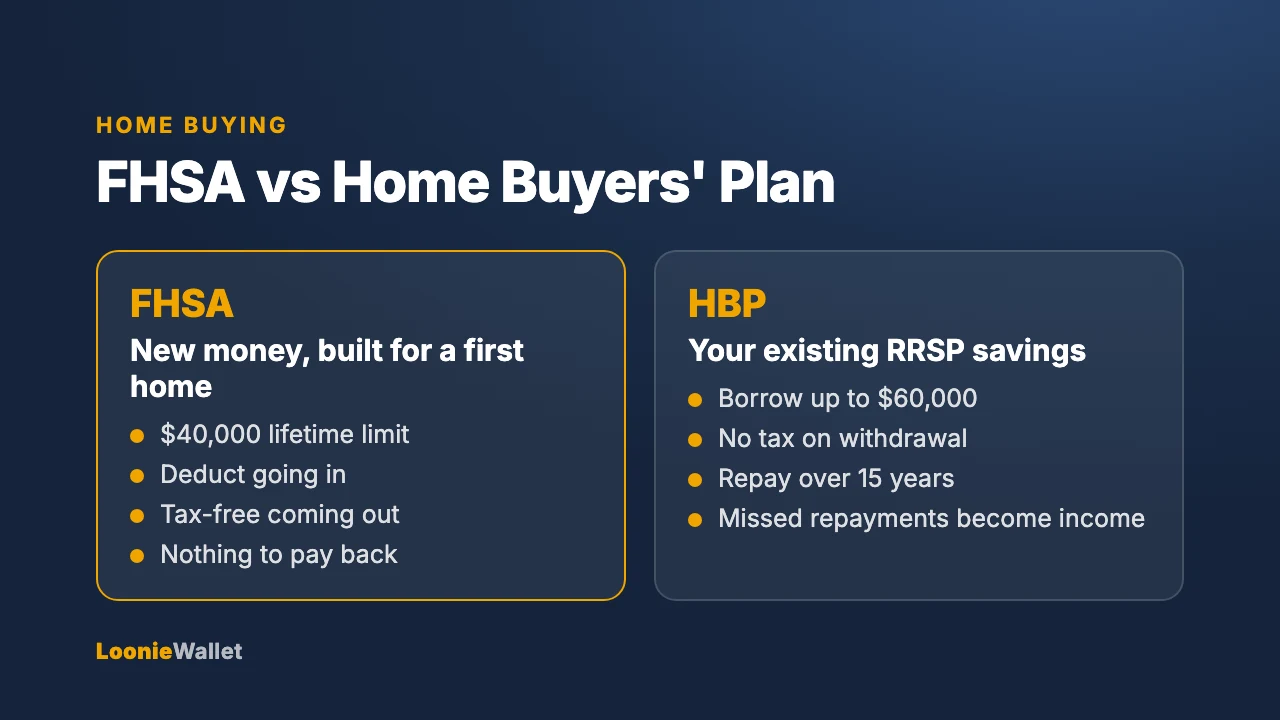
- RRSP via the Home Buyers’ Plan if you already have RRSP savings or an employer match. Compare it with the FHSA here.
- TFSA for everything above those limits and for any part of the plan that is not certain.
For the full sequence with worked examples for a single buyer and a couple, see the down-payment strategy guide.
This article is for education, not tax advice. Eligibility and room are personal; confirm both with the CRA before moving money. Limits, rates and rules on this page are as of the time of writing and can change without notice; confirm current figures with the CRA before you act.
About LoonieWallet
LoonieWallet is an independent resource created to help make smarter financial decisions. We research and publish fact-based guides, tutorials, and product reviews covering money transfers, fintech apps, and personal finance tools. Our mission is to make personal finance easier and clearer so readers can save time, money, and stress.
Read more about us here. If you have any questions, you can contact us using this page.
Sources
Checked on Sep 18, 2026 (CRA 2026 TFSA and FHSA limits, FHSA eligibility and qualifying-withdrawal rules, TFSA withdrawal room rule).
- Opening your FHSAs — Canada Revenue Agency
- Participating in your FHSAs — Canada Revenue Agency
- Withdrawals and transfers out of your FHSAs — Canada Revenue Agency
- Calculate your TFSA contribution room — Canada Revenue Agency