LoonieWallet Team · Mortgage · Last verified
Mortgage Renewal in Canada: The 2026 Checklist and Payment Comparison
Renewing a mortgage in 2026? Here is what your payment does at today's rates, when you can switch lenders without requalifying, what a switch costs, and a 120-day checklist.
If your mortgage comes up for renewal in 2026, three things are true at once. Your rate is almost certainly going up. You probably do not have to pass the stress test to move it. And the payment increase is a number you can calculate today, not a surprise for renewal day.
This guide gives you the number first, then the decisions.
The short version
- Payment increase. A mortgage signed at 1.89% in 2021 and renewed at about 4.24% with 20 years of amortization left rises roughly 23%, whatever the balance. On a $418,000 balance that is about $486 more a month.
- Requalifying. You never requalify to renew with your current lender. Since November 21, 2024, OSFI also does not require the stress test when you switch an uninsured mortgage to another federally regulated lender without increasing the amount or the amortization. Insured mortgages were already exempt.
- Switching cost. No prepayment penalty at maturity. Budget for discharge, registration or assignment, appraisal and administration fees, which many lenders cover to win your business.
- Rates on 2026-09-17. Bank of Canada policy rate 2.25%, prime 4.45%, lowest advertised insured 5-year fixed 4.24%, lowest 5-year variable 3.30%. These are observations, not a forecast.
Why 2026 is still a renewal shock year
The Bank of Canada estimates that about 60% of all outstanding mortgages renew in 2025 or 2026. Its July 2025 analysis projects that borrowers with five-year fixed mortgages renewing in those two years face payment increases of around 15% to 20% compared with their December 2024 payments. Variable-rate borrowers with variable payments, by contrast, could see payments fall 5% to 7%, because their rate already rose and then fell with the policy rate.
CMHC’s Spring 2026 report says 2026 renewals are 13% fewer than 2025’s, but the borrowers renewing now are the ones who locked in the lowest rates of 2020 and 2021. CMHC also notes that average mortgage rates drifted from about 4.8% in January 2025 to about 4.2% in January 2026, so the shock is smaller than it would have been two years ago. It is not gone.
How much will your payment increase?
Run your own numbers. The default inputs are the 2021 borrower described above.
Payment now
Payment after renewal
Monthly change
| If your renewal rate is… | Monthly payment | Change vs now |
|---|
Keeping vs extending the amortization at the renewal rate
For reference, here is the matrix for three common balances, assuming the mortgage was 25 years at 1.89% five years ago and now has 20 years left. Fixed-rate mortgages in Canada compound semi-annually, which the figures reflect.
| Original mortgage | Payment now | Balance at renewal | At 3.50% | At 4.24% | At 5.00% |
|---|---|---|---|---|---|
| $400,000 | $1,673 | $334,301 | $1,934 | $2,062 (+$389) | $2,197 |
| $500,000 | $2,091 | $417,876 | $2,418 | $2,577 (+$486) | $2,746 |
| $750,000 | $3,136 | $626,814 | $3,627 | $3,866 (+$730) | $4,119 |
Two things stand out. The percentage increase is the same across balances because it is driven by the rate gap, not the size of the loan. And a quarter point matters less than people expect: on the $500,000 example, each 0.25% changes the payment by roughly $55 a month. That is worth negotiating for, but it should not decide whether you stay or switch on its own.
Do you have to requalify? Usually not
This is the fact most renewal articles get wrong or skip.
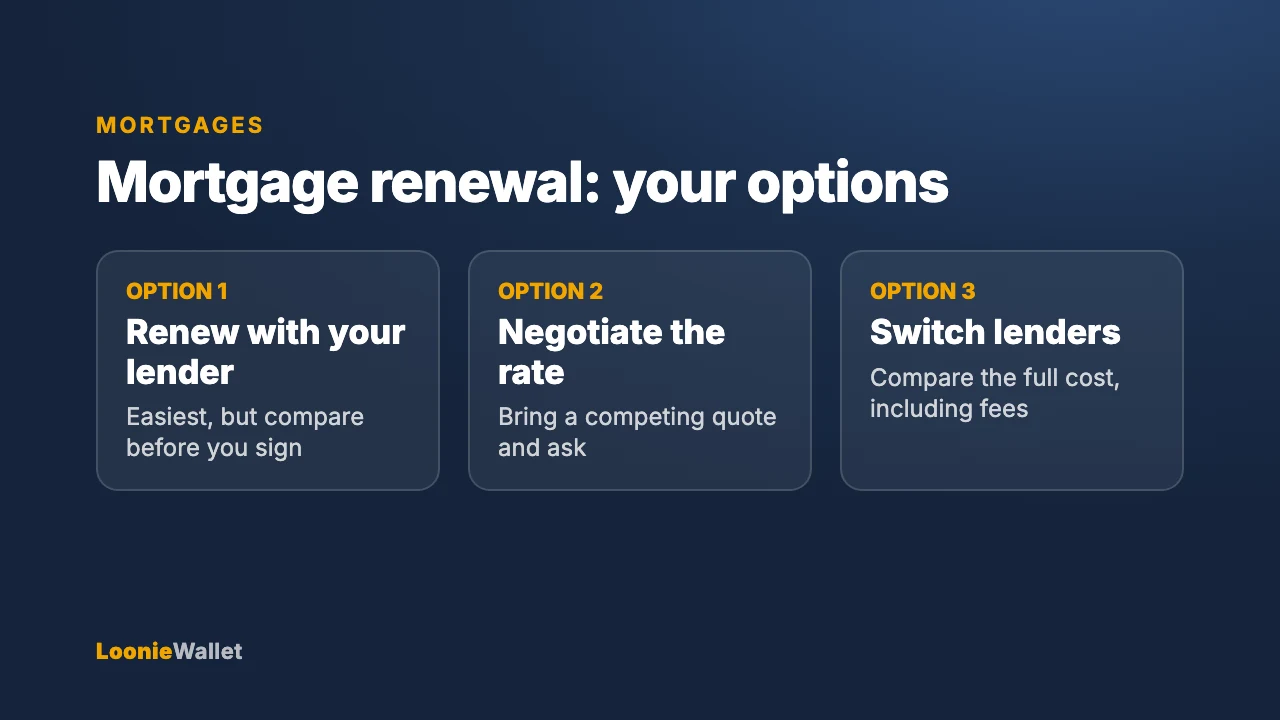
Renewing with your current lender: no stress test, no requalification, as long as you are not borrowing more. Your lender sends a renewal statement at least 21 days before the term ends and will renew you automatically if you do nothing. Automatic renewal is convenient and often expensive, because the rate on the statement is a starting offer.
Switching lenders, uninsured mortgage: since November 21, 2024, OSFI no longer requires federally regulated lenders to apply the minimum qualifying rate to a “straight switch”, meaning the same balance and the same remaining amortization moved from one federally regulated lender to another. Before that change, uninsured borrowers had to requalify at the greater of the contract rate plus 2% or 5.25% to leave, which trapped many people at their existing lender.
Switching lenders, insured mortgage: insured switches were already exempt from the stress test.
Borrowing more or extending the amortization: the new lender treats this as a new application. Expect to qualify at the greater of your contract rate plus 2% or 5.25%, and if the mortgage is insured, expect an insurance premium on any increase. Our affordability calculator shows what that qualification looks like.
The new lender still runs its own credit and income checks. The exemption removes the stress-test rate, not the application.
Stay or switch: how to compare
Your current lender has one advantage: switching costs nothing with them. A competing lender has a different one: it has to earn the mortgage. Compare on three lines.
1. The rate over the term. On the $417,876 example, a 0.20% lower rate saves about $44 a month, or roughly $2,600 over a five-year term. That is the number to weigh the switching costs against.
2. Switching costs. The FCAC lists what a switch can involve: setup fees such as discharge, registration, transfer or assignment fees; an appraisal to confirm the property value; administration fees; a mortgage insurance premium if the amount or amortization increases; and, if your current mortgage is registered as a collateral charge, the cost of removing it, which usually means a lawyer or title company. Many lenders and brokers cover some or all of these for a straight switch. Get the list in writing before you decide.
3. Terms you actually use. Prepayment privileges (how much extra you can pay each year without penalty), portability (whether you can move the mortgage to a new home), and the penalty method if you break the mortgage early. A big-bank fixed mortgage typically calculates its penalty on posted rates, which produces a much larger interest rate differential than a lender that uses contract rates. If there is any chance you sell or refinance in the next five years, this matters more than a few basis points.
If the competing offer wins on line 1 by more than it costs on line 2, tell your current lender. The FCAC’s advice is exactly that: lenders often match when shown a competing offer.
Fixed, variable, or short fixed
Borrowers renewing in 2026 are not all choosing the traditional five-year fixed. CMHC reports that in February 2026, variable rates were the most popular choice for extended mortgages at chartered banks at 42%, fixed terms of three to under five years took 35%, and the classic five-year fixed only 11%.
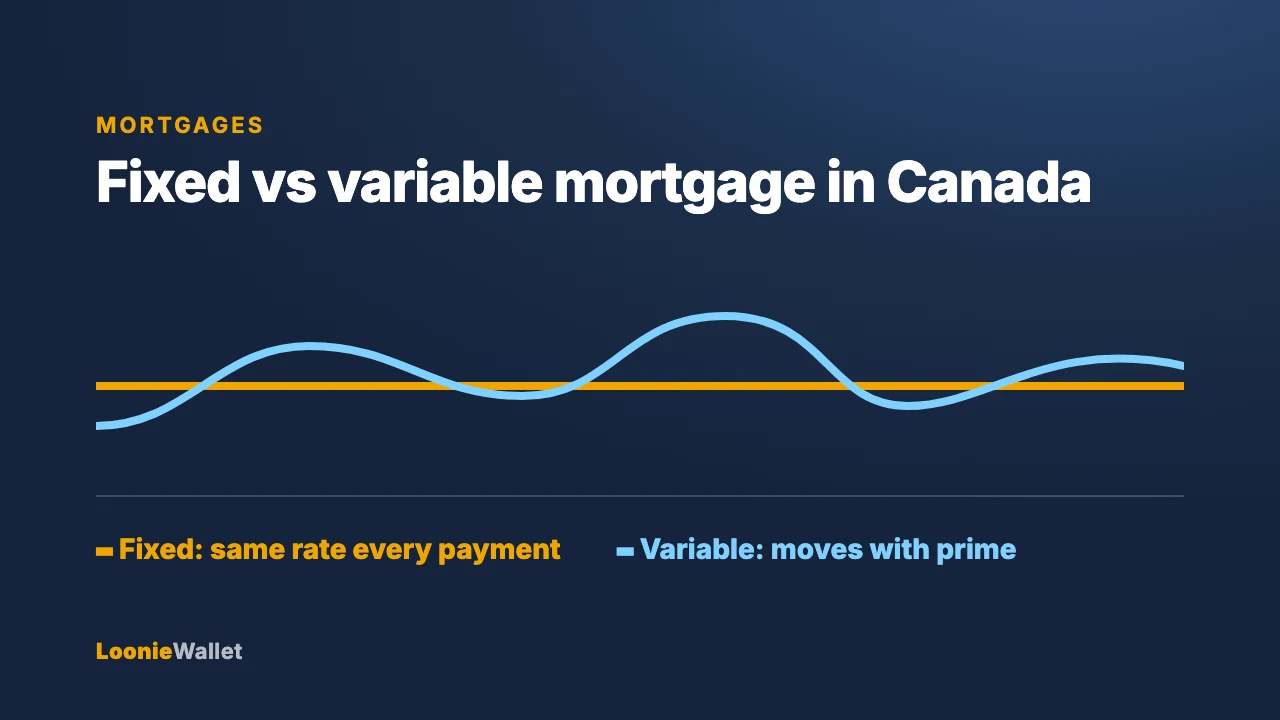
On 2026-09-17, the lowest advertised five-year variable rate was 3.30% against 4.24% for the lowest insured five-year fixed. The gap is the premium you pay for certainty. Whether it is worth paying depends on how much a rate increase would hurt your budget, not on anyone’s forecast. Three questions settle it:
- If your variable rate rose by 1% within two years, could you absorb the higher payment? If not, fix.
- Are you likely to sell or refinance before the term ends? Variable mortgages usually carry a three-months’ interest penalty, fixed mortgages the greater of three months’ interest or the interest rate differential, which can be far larger.
- Do you want the option to lock in later? Most variable mortgages allow conversion to a fixed term without penalty, at the lender’s rate that day.
A three-year fixed is the compromise many are taking: a shorter commitment at a fixed payment, with a renewal sooner if rates fall. We cover the trade-offs, three rate paths, and the penalty gap in Fixed vs variable mortgage in Canada.
Extending your amortization: relief now, interest later
If the new payment does not fit, lenders may offer to re-amortize over 25 or 30 years. Here is what that costs on the $417,876 balance at 4.24%:
| Amortization | Monthly payment | Total interest over the mortgage |
|---|---|---|
| 20 years (what remains) | $2,577 | $200,646 |
| 25 years | $2,253 | about $257,000 |
| 30 years | $2,044 | $318,044 |
Stretching to 30 years cuts the payment by $533 a month and adds about $117,000 of interest, assuming the rate held for the whole period. The FCAC’s warning is blunt: extending can cost “thousands or tens of thousands of dollars” more. It is a reasonable bridge if the alternative is missing payments. If you take it, use prepayment privileges to shorten the amortization again once cash flow allows, and note that extending usually means a full application rather than a straight switch.
Early renewal and blend-and-extend
Most lenders let you renew 120 to 180 days before maturity with a rate hold. If the rate hold is lower than today’s offer and rates rise before your maturity date, you keep the lower rate; if rates fall, most lenders will give you the lower rate at maturity. Ask whether the hold is a “floating down” hold. This is the cheapest insurance in the process and there is rarely a reason not to take it.
Blend-and-extend is different: the lender blends your current rate with today’s rate into a new, longer term before your current term ends, with no penalty because the contract is amended rather than broken. It only helps if today’s rate is meaningfully below your current one. For 2021 borrowers renewing in 2026 that is rarely the case, so it is mostly a tool for people who signed in 2023 at higher rates.
The 120-day renewal checklist
- 120 to 180 days out: ask your lender for an early-renewal rate hold. Pull your balance, remaining amortization, and current prepayment privileges. Run the renewal calculator with a realistic rate.
- Same week: get two competing quotes, one from a broker and one from a lender you already bank with. Ask each for the itemized switch costs and which they cover.
- 90 days out: decide fixed, variable, or short fixed using the three questions above, and decide whether you need to extend the amortization. If you plan to borrow more, get a pre-approval, because that is a full application.
- 60 days out: take the best competing offer back to your current lender. Get any improved offer in writing.
- 21 days out: your lender’s renewal statement must arrive by now. Compare it line by line with your best offer. Do not sign an automatic renewal without checking the rate against the hold you already have.
- Maturity: if switching, the new lender and your current one handle the discharge and registration. Confirm the first payment date and that any prepayment you planned is set up.
Breaking early instead of waiting
If your rate is far above today’s and your term still has more than a year to run, the penalty may be worth paying, but do the math. For a fixed mortgage the penalty is usually the higher of three months’ interest or the interest rate differential; the IRD applies when your rate is above the lender’s current rate for the remaining term and can run to tens of thousands of dollars on a posted-rate calculation. Lenders must show how they calculate it in the prepayment disclosure box of your mortgage documents, and the FCAC’s own advice is to consider waiting for maturity when the penalty is large.
Sources and verification
Every rule on this page was checked against the OSFI, FCAC, Bank of Canada and CMHC pages listed below on the verification date shown above. Rates are observations from that date and will change; the calculator lets you enter today’s.
This article is for education, not mortgage advice. Your lender’s terms, your credit profile, and your province’s registration costs determine your actual options. Talk to a licensed mortgage professional before signing.
About LoonieWallet
LoonieWallet is an independent resource created to help make smarter financial decisions. We research and publish fact-based guides, tutorials, and product reviews covering money transfers, fintech apps, and personal finance tools. Our mission is to make personal finance easier and clearer so readers can save time, money, and stress.
Read more about us here. If you have any questions, you can contact us using this page.
Sources
Checked on Sep 18, 2026 (OSFI qualifying-rate rules, FCAC renewal and penalty rules, Bank of Canada and CMHC renewal data, rate observations).
- Minimum qualifying rate for uninsured mortgages — Office of the Superintendent of Financial Institutions
- Renewing your mortgage — Financial Consumer Agency of Canada
- Mortgage fees: prepayment penalties — Financial Consumer Agency of Canada
- How will mortgage payments change at renewal? An updated analysis (Staff Analytical Note 2025-21) — Bank of Canada
- Bank of Canada maintains the policy rate at 2¼% (September 2, 2026) — Bank of Canada
- Residential Mortgage Industry Report, Spring 2026 — Canada Mortgage and Housing Corporation
- Best 5-year fixed mortgage rates (rate observation, September 17, 2026) — Ratehub.ca