LoonieWallet Team · Investment · Last verified
FHSA Complete Guide: Contributions, Deductions, Withdrawals, and What Happens If You Don't Buy
How the First Home Savings Account works in 2026: who qualifies, the $8,000 and $40,000 limits, how the deduction works, the exact conditions for a tax-free withdrawal, and your options if you never buy.

The First Home Savings Account (FHSA) is the only Canadian registered account that gives you a tax deduction when money goes in and tax-free money when it comes out, provided it comes out for a first home. That combination is why it should be the first account a future first-time buyer fills.
This guide covers the rules as the CRA publishes them, the parts most articles skip (the withdrawal conditions, the closing deadlines, and what happens if you never buy), and how the FHSA fits with the TFSA and the RRSP Home Buyers’ Plan.
The FHSA in one table
| Annual participation room | $8,000 per year, starting the year you open the account |
| Lifetime limit | $40,000 |
| Carry-forward | Unused room carries forward, to a maximum of $8,000. So the most you can put in during one year is $16,000. |
| Contributions | Tax-deductible, like an RRSP. You can claim the deduction in a later year. |
| Growth | Tax-free inside the account |
| Qualifying withdrawal | Tax-free, no dollar limit, never repaid |
| If you don't buy | Transfer to an RRSP or RRIF tax-free without using RRSP room, or withdraw and pay tax |
| Account lifespan | Closes at the earliest of 15 years after opening, the year you turn 71, or the year after your first qualifying withdrawal |
| Over-contribution tax | 1% per month on the highest excess amount in the month |
Source: CRA FHSA pages listed at the end of this guide, verified 2026-09-18.
Who can open an FHSA
You can open an FHSA if, at the time you open it, all of the following are true:
- You are at least 18 (or 19 where that is the age of majority in your province) and no older than 71 on December 31 of the year you open it.
- You are a resident of Canada.
- You are a first-time home buyer. The CRA’s definition is specific: you did not live in a home that you owned or jointly owned as your principal residence at any time in the current calendar year or the previous four calendar years. The same test applies to a home your spouse or common-law partner owned while you lived there. If you have no spouse or partner, only your own history counts.
Two consequences of that definition surprise people. First, having owned a rental property you never lived in does not disqualify you. Second, a partner who has owned a home you both lived in does disqualify you for as long as that ownership falls inside the four-year window, even if the title was never in your name.
Newcomers to Canada qualify as soon as they are residents, and homes owned outside Canada count as homes for this test if you lived in them.
Contribution room: how it actually accrues
Room only starts when you open the account. Unlike the TFSA, there is no room accumulating in the background from the year you turned 18. Someone who opens an FHSA in December 2026 gets the full $8,000 of room for 2026 and another $8,000 on January 1. That makes “open it now, fund it later” the right move even if you cannot contribute yet.
The carry-forward is capped. If you contribute nothing for three years, you do not have $24,000 of unused room; you have $8,000 of carried room plus the current year’s $8,000, for a maximum single-year contribution of $16,000. The lifetime ceiling stays at $40,000, which you reach in five years of maximum contributions.
Transfers from an RRSP count against your FHSA room but are not deductible again, since you already deducted them going into the RRSP. They do not restore the RRSP room they came from. A transfer makes sense if you have RRSP savings earmarked for a home and want them to come out tax-free instead of through the Home Buyers’ Plan with its repayment schedule.
Contributions made in the first 60 days of the year count for that calendar year, not the previous one. This is the opposite of the RRSP rule, and it catches people who try an FHSA “top-up” in February for last year’s return.
The deduction: worth as much as an RRSP deduction
An FHSA contribution reduces your taxable income exactly as an RRSP contribution does. At a combined marginal rate of 30%, an $8,000 contribution reduces your tax by about $2,400. At 43%, about $3,440. Our RRSP tax refund calculator gives the figure for your income and province; the arithmetic is identical for an FHSA.
You do not have to claim the deduction in the year you contribute. If you are early in your career and expect a higher income soon, contribute now to build the tax-free growth and claim the deduction in the higher-income year, when it is worth more. The CRA tracks unclaimed FHSA deductions the same way it tracks unused RRSP deductions.
What you can hold
The same qualified investments as a TFSA or RRSP: cash, high-interest savings, GICs, ETFs, stocks, bonds, and mutual funds. Because the money has a defined purpose and often a defined date, the mix should follow the timeline. Money you will need within two or three years belongs in savings or GICs; a five-year-plus horizon can carry more equity risk. Losses inside an FHSA cannot be claimed against anything.
Making a qualifying withdrawal: the five conditions
This is where the FHSA’s value is either captured or lost. To take money out tax-free you must meet all of the following at the time of the withdrawal, and you confirm them on Form RC725 given to your FHSA issuer:
- You are a first-time home buyer again, tested at the withdrawal date. You did not live in a home you owned as your principal residence in the current calendar year before the withdrawal (apart from the 30 days immediately before it) or in the previous four calendar years. The 30-day exception exists so you can close on the home and still withdraw shortly after.
- You have a written agreement to buy or build a qualifying home with an acquisition or completion date before October 1 of the year following the withdrawal. Withdraw in November 2026 and the home must be yours by September 30, 2027.
- You are a resident of Canada from the withdrawal until the home is acquired.
- You intend to occupy the home as your principal residence within one year of buying or building it.
- The home is in Canada.
Meet all five and the entire withdrawal, contributions and growth alike, is tax-free with no upper limit and nothing to repay. You can take it in more than one withdrawal, but the clock starts at the first one.
After the first qualifying withdrawal, you must close every FHSA you hold by December 31 of the following year. Anything left can be transferred to an RRSP or RRIF tax-free or withdrawn as taxable income. Miss the deadline and the remaining balance is treated as income at fair market value.
If you don’t buy a home
An FHSA is not a bet you can lose. The account closes at the earliest of three dates: the 15th anniversary of opening your first FHSA, the end of the year you turn 71, or the end of the year after your first qualifying withdrawal. Before that date you have two exits:
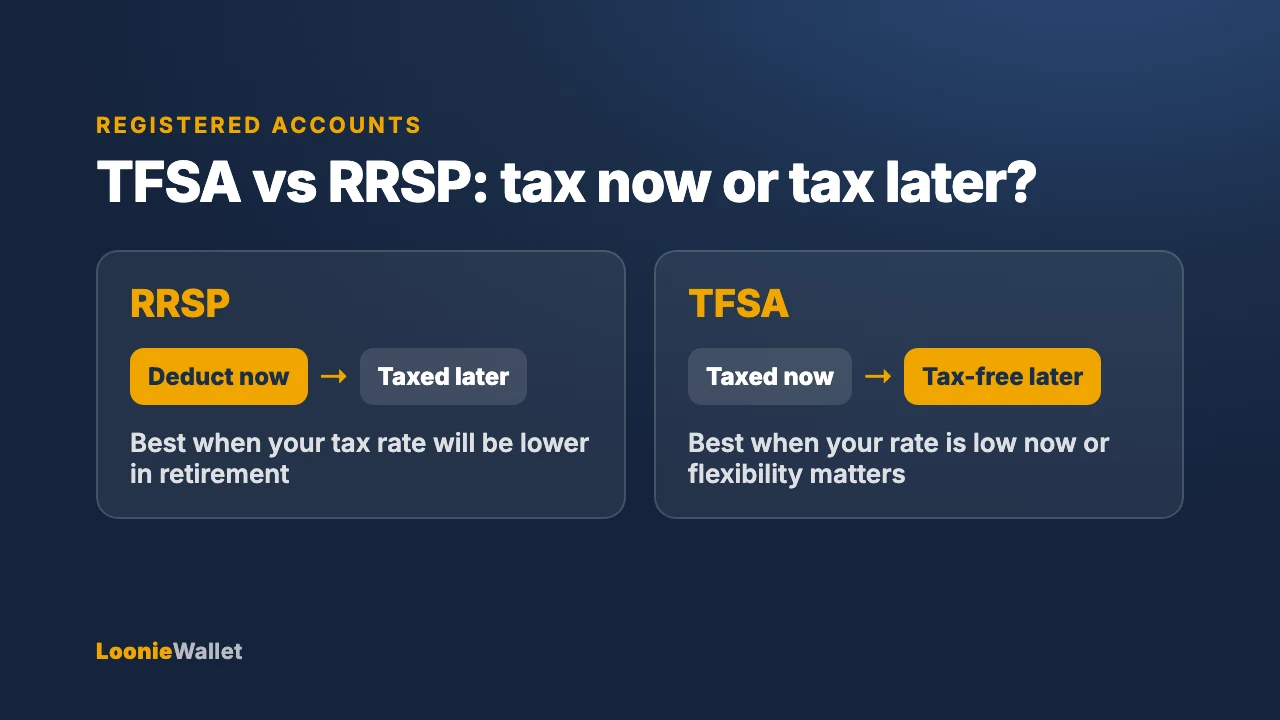
- Direct transfer to an RRSP or RRIF. Tax-free, and it does not use any RRSP contribution room. Your down-payment fund becomes retirement savings that already earned a deduction going in. This is the default outcome for anyone who decides not to buy.
- Taxable withdrawal. The amount is added to your income for the year and your issuer withholds tax on it. Only sensible if you need the cash and are in a low-income year.
The practical rule: open the FHSA if there is any real chance you will buy in the next 15 years. The downside case is an RRSP contribution you already made.
Over-contributions
Exceed your participation room and the CRA charges 1% per month on the highest excess amount in each month it remains, reported on Form RC728. You remove the excess by designating a withdrawal or a transfer to your RRSP on Form RC727, so the excess does not count as income. Excess contributions earn no deduction, and the tax runs until the excess is gone, so act in the same month you notice.
The common cause is opening FHSAs at two institutions and contributing $8,000 to each. Room is per person, not per account. The same 1%-a-month rule applies to TFSA and RRSP excess amounts, with different forms and deadlines.
FHSA vs TFSA vs RRSP Home Buyers’ Plan
| Feature | FHSA | TFSA | RRSP via HBP |
|---|---|---|---|
| Deduction on contribution | Yes | No | Yes |
| Tax on withdrawal for a home | None | None | None, but must be repaid |
| Room | $8,000/yr, $40,000 lifetime | $7,000/yr, up to $109,000 total | Withdraw up to $60,000 |
| Repayment | None | None (room returns next year) | Over 15 years; withdrawals made 2022–2028 start repaying in the fifth year |
| If you never buy | Roll into RRSP tax-free | Nothing changes | Stays in RRSP |
| Best used | First | For flexibility and overflow | Second, if you already have RRSP savings |
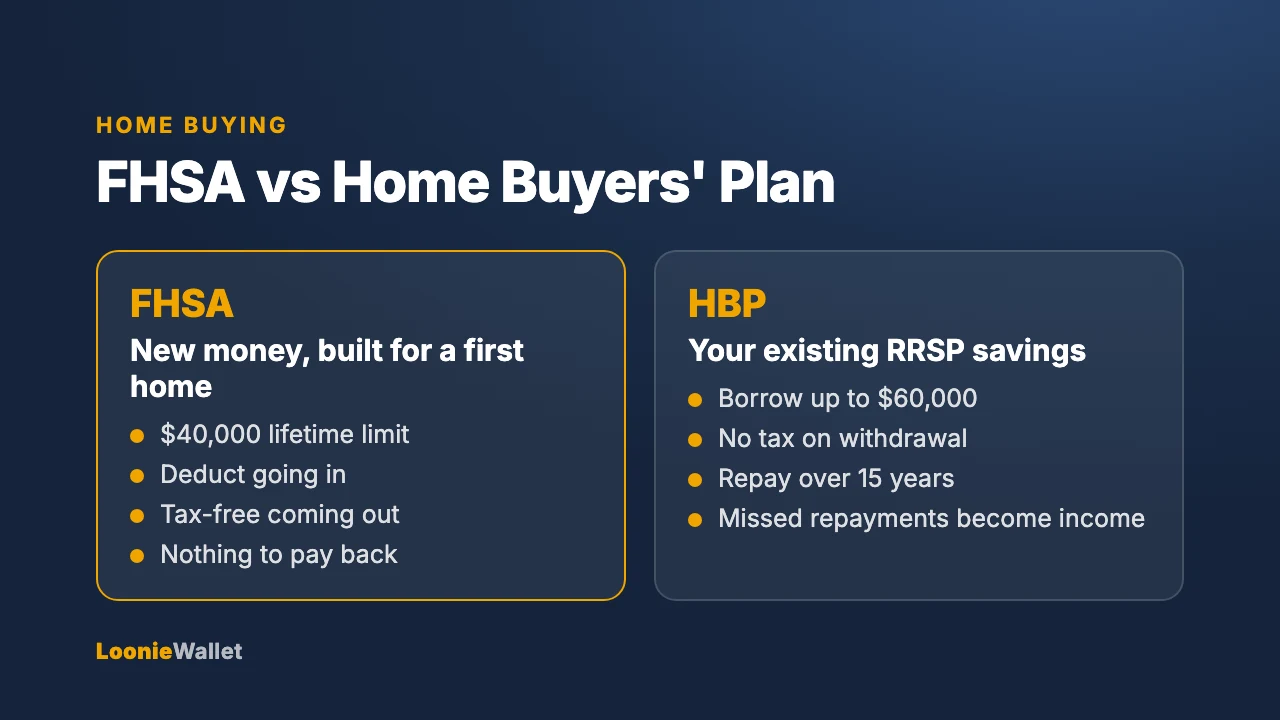
The order of operations for most first-time buyers is FHSA first, then the Home Buyers’ Plan if you have RRSP savings, then the TFSA for whatever else you can save. Per person, that is $40,000 plus growth from the FHSA and up to $60,000 from the RRSP. A couple who both qualify can combine $120,000 of HBP withdrawals with two FHSAs. All three can be used on the same purchase.
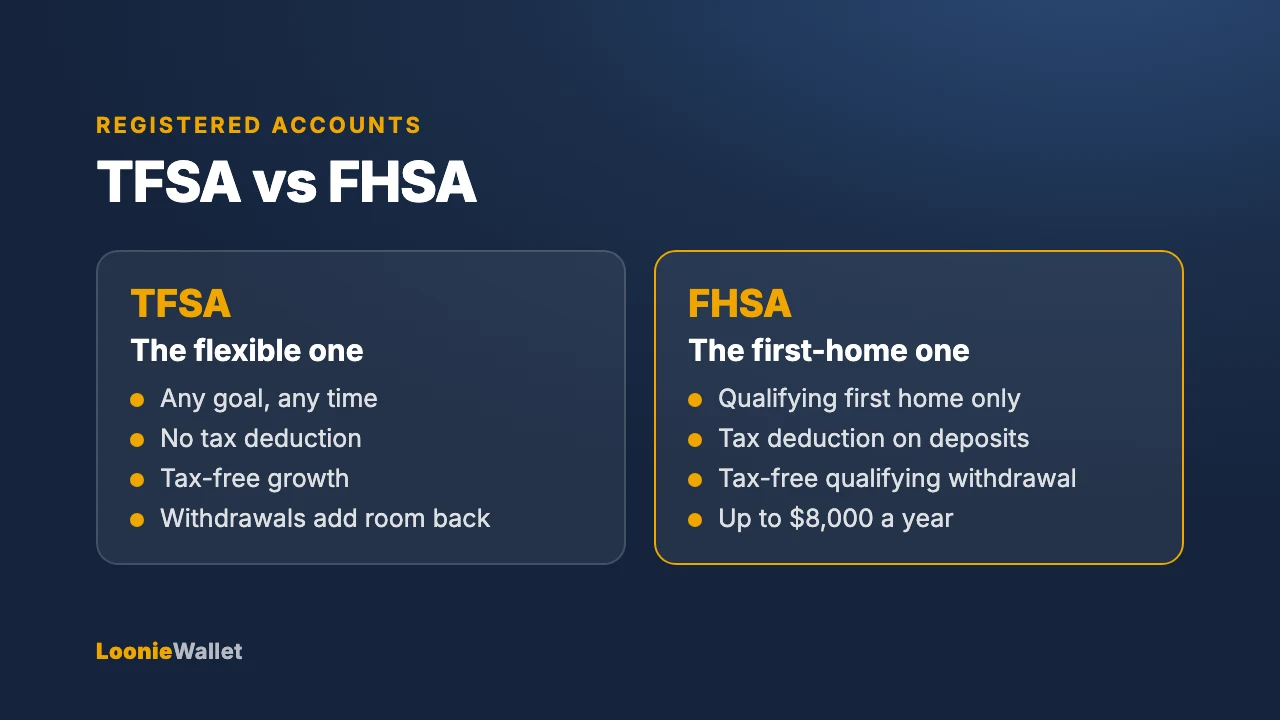
If you already have TFSA savings set aside for a home, the move most people miss is to withdraw $8,000 a year from the TFSA and contribute it to the FHSA. The TFSA room comes back the following January, and each transfer earns a deduction that the money never earned sitting in the TFSA.
How big is the FHSA already?
The CRA’s most recent published statistics show 739,000 people had opened an FHSA by December 31, 2023, holding $2.79 billion, an average of about $3,900 per account nine months after launch. Adoption has continued since, but the CRA has not published a newer figure as of this guide’s verification date.
Opening an FHSA
Every major bank, credit union, and online brokerage offers one. Choose on the same criteria as any registered account: no annual fee, access to the investments you want (an FHSA at a brokerage can hold ETFs; one at a bank branch may be limited to GICs and mutual funds), and easy transfers to your RRSP if you need the exit. Open it before the end of the year even with $0 in it, because that starts your room.
Common mistakes
- Waiting to open until you can contribute. Room starts at opening, not at 18.
- Treating the 60-day rule like an RRSP. January and February FHSA contributions count for the new year.
- Withdrawing before you have a signed agreement. That is a taxable withdrawal, not a qualifying one.
- Forgetting the October 1 deadline. A withdrawal late in the year needs a closing date by September 30 of the next year.
- Leaving money in after buying. Close all FHSAs by December 31 of the year after your first qualifying withdrawal.
- Two FHSAs, double contributions. Room is per person.
Related guides
- TFSA vs FHSA: which should a first-time buyer use first?
- FHSA vs RRSP Home Buyers’ Plan
- FHSA + RRSP + TFSA: a down-payment strategy with worked examples
- TFSA complete guide
- RRSP complete guide, including the Home Buyers’ Plan
- TFSA vs RRSP: which to fund first
- Mortgage affordability calculator
This guide is for education, not tax advice. The CRA pages listed below are the authority; confirm your own eligibility and room before contributing or withdrawing, and consult a tax professional for your situation. Limits, rates and rules on this page are as of the time of writing and can change without notice; confirm current figures with the CRA before you act.
About LoonieWallet
LoonieWallet is an independent resource created to help make smarter financial decisions. We research and publish fact-based guides, tutorials, and product reviews covering money transfers, fintech apps, and personal finance tools. Our mission is to make personal finance easier and clearer so readers can save time, money, and stress.
Read more about us here. If you have any questions, you can contact us using this page.
Sources
Checked on Sep 18, 2026 (CRA FHSA eligibility, participation room, qualifying withdrawal conditions, closing rules, excess-amount tax, HBP limit and repayment).
- Opening your FHSAs — Canada Revenue Agency
- Participating in your FHSAs (contributions and participation room) — Canada Revenue Agency
- Withdrawals and transfers out of your FHSAs — Canada Revenue Agency
- Closing your FHSAs — Canada Revenue Agency
- What happens if you contribute or transfer too much to your FHSAs — Canada Revenue Agency
- What is the Home Buyers' Plan (HBP)? — Canada Revenue Agency
- FHSA statistics — Canada Revenue Agency