LoonieWallet Team · Investment · Last verified
TFSA vs RRSP: Which Should You Fund First?
One rule decides it: your tax rate today versus your tax rate when you withdraw. Here is that rule with 2026 numbers for every income level, the two exceptions that override it, and a calculator for your own case.
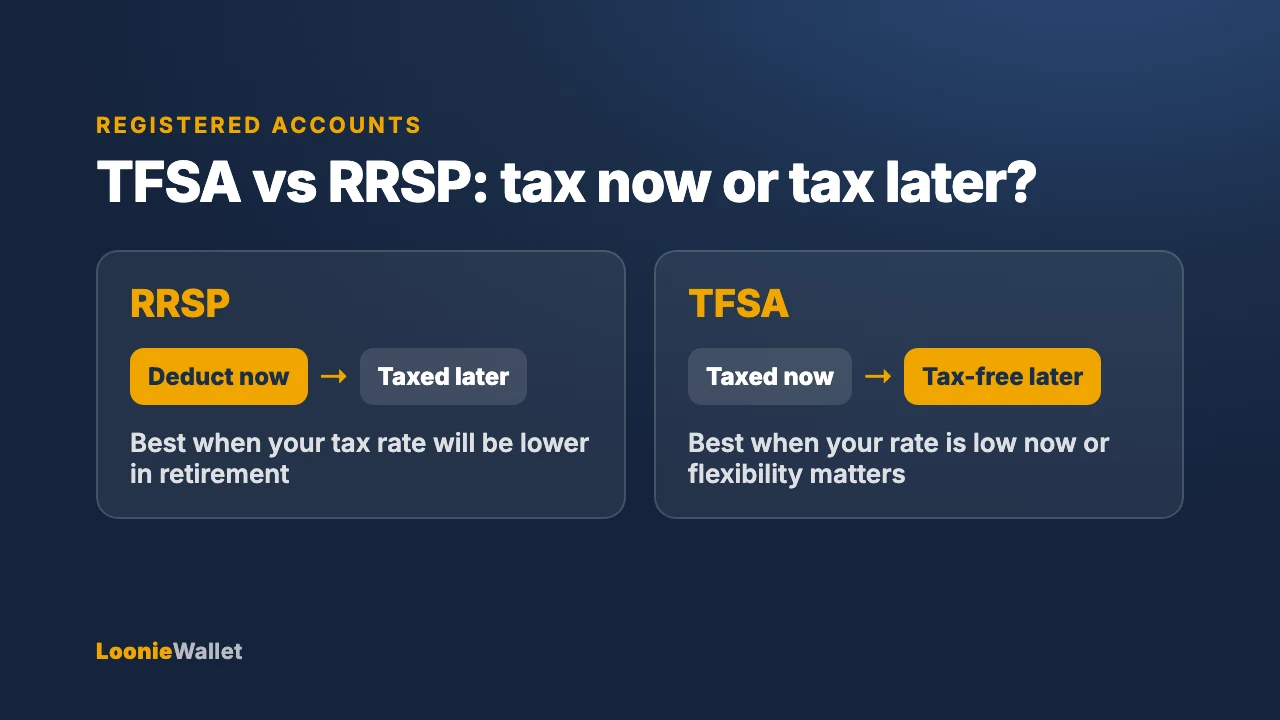
The TFSA-or-RRSP question has a clean answer, and it is not “it depends on your goals.” It depends on two numbers: the tax rate your contribution saves you today and the tax rate you will pay when the money comes out. Everything else, including the “RRSP is for retirement, TFSA is for everything else” framing, is a consequence of those two numbers.
This guide gives you the rule, shows it in dollars for four incomes, names the two exceptions that override it, and then hands you the calculator.
The rule in one paragraph
An RRSP contribution is deducted from your income, so the government effectively lends you the tax on it. You pay that tax back at withdrawal, at whatever rate applies then. A TFSA contribution is made with money you already paid tax on, and withdrawals are free. Put the same pre-tax dollars in each and let them grow identically, and the outcome is decided entirely by the two rates:
- Rate now higher than rate at withdrawal: the RRSP wins. You deducted at a high rate and pay back at a low one.
- Rates equal: a tie. The accounts produce the same after-tax result, and the TFSA’s flexibility breaks the tie.
- Rate now lower than rate at withdrawal: the TFSA wins. The RRSP would have you paying back more than you saved.
“Rate at withdrawal” is your combined federal and provincial marginal rate in the year you take the money out, including the effect on income-tested benefits. For most people that is retirement, but for the Home Buyers’ Plan or an early-career withdrawal it is much sooner.
What the rule looks like in dollars
The table takes a $10,000 RRSP contribution in Ontario at four incomes using 2026 federal and provincial rates, grows it at 6% a year for 25 years, and compares it with the after-tax equivalent in a TFSA. The “saves” column is the average rate the deduction actually saves, which is a little below the marginal rate when the contribution crosses into a lower bracket.
| Income (ON) | Deduction saves | TFSA after 25 yrs | RRSP, 20% at withdrawal | RRSP, 30% at withdrawal | RRSP, 40% at withdrawal |
|---|---|---|---|---|---|
| $45,000 | 19.1% | $34,743 | $34,335 about even | $30,043 TFSA by $4,700 | $25,751 TFSA by $8,991 |
| $65,000 | 27.4% | $31,176 | $34,335 RRSP by $3,159 | $30,043 TFSA by $1,133 | $25,751 TFSA by $5,425 |
| $95,000 | 29.7% | $30,186 | $34,335 RRSP by $4,149 | $30,043 about even | $25,751 TFSA by $4,434 |
| $130,000 | 43.4% | $24,288 | $34,335 RRSP by $10,047 | $30,043 RRSP by $5,755 | $25,751 RRSP by $1,463 |
Assumptions: single filer, only the basic personal amount, Ontario surtax included, no employer match, refund not reinvested. Other provinces shift the “saves” column by a few points; the pattern is identical. Generated from LoonieWallet’s tax engine using CRA 2026 rates, verified 2026-09-18.
Read the table across any row. At $45,000, the deduction saves about 19%; at a 20% withdrawal rate the two accounts finish about even, and at 30% or more the TFSA is ahead. At $65,000, the RRSP wins only if you expect to pay 20% on withdrawal. At $95,000, the deduction saves about 30%, so the RRSP wins at 20%, ties at 30%, and loses at 40%. At $130,000, the deduction saves about 43% and the RRSP is ahead in every column, even at a 40% withdrawal rate.
That is the entire decision. The income bands people quote (“under $50,000 use a TFSA, over $100,000 use an RRSP”) are a shortcut for “your rate now is probably lower or higher than your rate in retirement.” The shortcut is usually right and occasionally badly wrong, which is why the next section matters.
Two exceptions that override the rule
1. Employer matching. If your employer matches RRSP or group-RRSP contributions, the match is an immediate return of 50% to 100% on your money. No tax-rate argument survives that. Contribute enough to capture the full match before putting a dollar anywhere else, even in a low-income year.
2. Income-tested benefits in retirement. RRSP and RRIF withdrawals count as income. TFSA withdrawals do not. For someone who will rely on the Guaranteed Income Supplement, every dollar of RRSP withdrawal can reduce GIS by 50 cents, which makes the effective withdrawal rate far higher than the table shows. Old Age Security starts to be clawed back at net income above $95,323 in 2026. If your retirement income will be modest, weight the TFSA more heavily than the tax rates alone suggest. If it will be high enough that OAS is clawed back anyway, the RRSP’s deferral matters more.
What “rate at withdrawal” really is
The table treats it as a single number you choose. In practice, think about it in three cases:
- Retirement. Add up CPP, OAS, any pension, and the income your savings would produce. Many Canadians who earned $95,000 in their working years land in the 20% to 30% range in retirement, which is why the RRSP tends to win for middle and upper-middle earners.
- A home purchase through the Home Buyers’ Plan. You withdraw up to $60,000 tax-free and repay it over 15 years, so the “withdrawal rate” is zero as long as you repay. For a first-time buyer, the FHSA beats both accounts, because the deduction comes with no repayment at all; see FHSA vs Home Buyers’ Plan.
- An emergency in a working year. You pay tax at your full marginal rate, plus withholding of 10% to 30% up front, and the contribution room is gone for good. If there is a real chance you will need the money before retirement, that is a TFSA use case regardless of the table.
When the TFSA should come first
- Your income is in the lowest federal bracket, which for 2026 means taxable income under $58,523, and you expect it to rise. Save the RRSP room; it never expires, and the deduction will be worth more later.
- You are saving for something within ten years that is not a first home: a wedding, a sabbatical, a car, an emergency fund.
- Your retirement income will be low enough that GIS or full OAS matters.
- You are a newcomer without earned income yet. RRSP room only appears after your first Canadian tax return; TFSA room starts the year you become a resident.
The 2026 TFSA limit is $7,000, and someone eligible since 2009 who has never contributed has $109,000 of room. Full rules are in the TFSA guide.
When the RRSP should come first
- Your marginal rate is above roughly 30% and you expect a lower rate in retirement. That covers most people earning above about $60,000 in most provinces.
- You have an employer match.
- You are within a few years of a first-home purchase, have already maxed the FHSA, and want the Home Buyers’ Plan on top.
- You are a high earner who has already maxed the TFSA. The RRSP’s 2026 limit is $33,810, far above the TFSA’s, and a spousal RRSP lets a higher-earning partner shift future income to a lower-earning one.
Two habits make the RRSP work harder. Reinvest the tax reduction, ideally into the TFSA, instead of spending it; the table assumes you spend it, so reinvesting improves every RRSP cell. And you do not have to claim the deduction in the year you contribute. Contribute in a low-income year to start the growth, and claim the deduction in a higher-income year when it saves more. Full rules are in the RRSP guide.
Why not both?
Most people who can save more than $7,000 a year end up using both, and the order still follows the rule: fill the account the rule favours first, then the other. A common pattern for someone earning $95,000: contribute to the RRSP for the deduction, put the tax reduction into the TFSA, and treat the TFSA as the flexible layer. The point of the rule is not to pick one account for life; it is to decide where this year’s dollars go.
Run your own numbers
The table uses one contribution, one province, and three withdrawal rates. The RRSP tax refund calculator uses your income, your province, your contribution, and the retirement rate you expect, and shows the RRSP and TFSA outcomes side by side. If the two results are within a few percent of each other, choose on flexibility and benefits; if they are far apart, the rate gap has already decided it.
This article is for education, not tax or investment advice. It uses a simplified tax model and does not account for CPP/EI credits, provincial health premiums, or your full benefit picture. Consult a tax professional for your situation. Limits, rates and rules on this page are as of the time of writing and can change without notice; confirm current figures with the CRA before you act.
About LoonieWallet
LoonieWallet is an independent resource created to help make smarter financial decisions. We research and publish fact-based guides, tutorials, and product reviews covering money transfers, fintech apps, and personal finance tools. Our mission is to make personal finance easier and clearer so readers can save time, money, and stress.
Read more about us here. If you have any questions, you can contact us using this page.
Sources
Checked on Sep 18, 2026 (CRA 2026 TFSA and RRSP limits, 2026 federal and provincial tax brackets, OAS recovery threshold).
- MP, DB, RRSP, DPSP, ALDA, TFSA limits and the YMPE — Canada Revenue Agency
- Income tax rates and brackets for 2026 — Canada Revenue Agency
- Indexation adjustment for personal income tax and benefit amounts (OAS recovery threshold) — Canada Revenue Agency
- Tax rates on RRSP withdrawals — Canada Revenue Agency