LoonieWallet Team · Investment · Last verified
Asset Location in Canada: What to Hold in a TFSA, RRSP and Taxable Account
Which ETF goes in which account is a tax question with a clear order of operations: fill the registered accounts first, then place the income that is taxed hardest where it is sheltered best. The rules that decide it, a worked example, and why the answer for most people is simpler than the forum threads suggest.
“Asset location” means deciding which investments go in which account, once you have more than one kind of account. It is different from asset allocation (how much in stocks versus bonds), and it matters only after the allocation is set. It also matters much less than the internet suggests. For most Canadians the whole subject reduces to three rules, which this guide states first and justifies afterward.
The three rules
- Fill the tax-sheltered accounts before you think about location. Every dollar in a TFSA, RRSP or FHSA grows untaxed. No placement trick in a taxable account beats that. If your registered room is not full, asset location is not your problem yet.
- When you do have a taxable account, put the income that is taxed hardest in the shelter. Interest and foreign dividends are taxed at your full marginal rate outside a registered account. Canadian dividends and capital gains are taxed at a discount. So bonds and foreign-dividend payers go inside; Canadian stocks and growth holdings are the least bad thing to hold outside.
- Only chase U.S. withholding tax in the RRSP once the balance is large. Holding U.S.-listed ETFs directly in an RRSP avoids the 15% treaty withholding on U.S. dividends. The saving is roughly a tenth of a percent a year of the U.S. holding. It is real, but it requires converting currency and managing more tickers, and below six figures the effort usually costs more than it saves.
If you hold one all-in-one ETF in each account, you are already following rules one and three and ignoring rule two. That is a perfectly good outcome; the rest of this page is for people who want to know what they are giving up.
How each kind of investment income is taxed
Inside a TFSA, RRSP or FHSA, none of this applies: nothing is taxed while it stays in the account (the RRSP taxes withdrawals as ordinary income). The table is about the taxable account, at the federal level, which is enough to show the ranking. Provinces add their own tax and their own dividend credits, but the order is the same everywhere.
| Income type | What is taxed | Federal treatment |
|---|---|---|
| Interest (bonds, GICs, savings) | 100% of it | Your full marginal rate |
| Foreign dividends (U.S. and international stocks) | 100% of it, after any withholding at source | Full marginal rate; withholding is generally creditable in a taxable account |
| Capital gains | 50% of the gain, only when you sell | Half your marginal rate, deferred until you sell |
| Eligible Canadian dividends | The dividend grossed up by 38% | Marginal rate on the grossed-up amount, minus a credit of 15.0198% of it |
The capital gains inclusion rate is one-half: the 2024 proposal to raise it to two-thirds was cancelled on March 21, 2025. The dividend figures are from the CRA’s line 12000 and line 40425 guidance.
The same $1,000 three ways
Take $1,000 of each income type for someone earning $95,000, whose federal marginal rate in 2026 is 20.5%. Federal tax only, so the provincial layer is left out on purpose; it changes the amounts but not the order.
| $1,000 received as | Amount included in income | Federal tax | Effective federal rate |
|---|---|---|---|
| Interest or foreign dividend | $1,000 | $205 | 20.5% |
| Capital gain (when realized) | $500 | $103 | 10.3% |
| Eligible Canadian dividend | $1,380 | $76 | 7.6% |
Interest costs 3 times as much federal tax as the same dollar of eligible dividends, and about twice as much as a capital gain. That ratio is the whole argument for asset location: if something has to sit outside the shelter, make it the dividend or the gain, not the interest.
Your combined federal and provincial marginal rate is what actually applies. For reference, the tax engine behind our RRSP calculator gives these 2026 combined marginal rates on interest:
| Income | ON | BC | AB | QC |
|---|---|---|---|---|
| $55,000 | 23.2% | 21.7% | 22.0% | 30.7% |
| $95,000 | 31.5% | 28.2% | 30.5% | 36.1% |
| $150,000 | 45.0% | 40.7% | 36.0% | 47.5% |
Marginal rate on the next dollar of ordinary income, including the Ontario surtax and Quebec abatement; excludes CPP/EI credits and benefit clawbacks. Provincial dividend credits and capital gains treatment follow the same pattern as the federal example.
Foreign withholding tax, account by account
Foreign governments withhold tax on dividends before they reach a Canadian fund. The U.S. rate is 30%, reduced to 15% by the Canada–U.S. treaty; developed international markets average about 10.49% (BlackRock’s estimate across MSCI EAFE). Whether you get any of it back depends on the account and on how the fund is built. The iShares reference guide summarizes it:
| What you hold | RRSP or RRIF | TFSA, FHSA or RESP | Taxable account |
|---|---|---|---|
| U.S.-listed ETF of U.S. stocks (e.g. VOO, ITOT) | Exempt from U.S. withholding | 15% withheld, lost | 15% withheld, creditable |
| Canadian-listed ETF of U.S. stocks (VFV, XUU, and the U.S. sleeve of XEQT or VEQT) | 15% withheld, lost | 15% withheld, lost | 15% withheld, creditable |
| Canadian-listed ETF of international stocks (XEF, VIU, the international sleeve of all-in-one funds) | Source-country tax withheld, lost | Withheld, lost | Withheld, creditable |
| U.S.-listed ETF of international stocks | U.S. layer exempt; source-country tax lost | Both layers lost | U.S. layer creditable; source layer lost |
| U.S. bonds, any structure | Exempt | Exempt | Exempt |
Three things follow. The only structure that escapes U.S. withholding is a U.S.-listed ETF held directly in an RRSP or RRIF. The TFSA and FHSA get no treaty relief at all, so U.S. dividends cost 15% there no matter what you do. And a taxable account recovers most of it through the foreign tax credit, which makes U.S. stocks less bad to hold outside the shelter than the raw 15% suggests.
What the RRSP exemption is worth
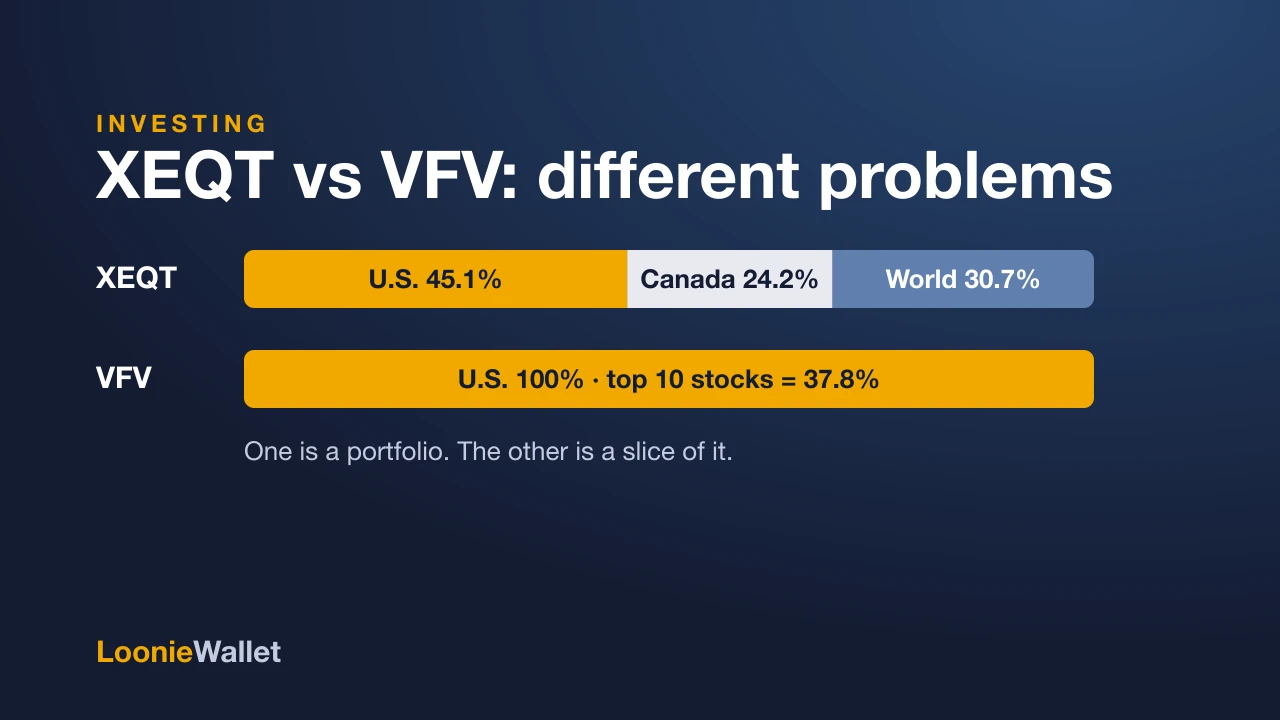
VFV’s trailing yield is 0.84%, so the withholding on it is about 0.13% of the holding per year. On a $50,000 U.S. position that is roughly $63 a year; on $250,000 it is $315. Capturing it means holding a U.S.-listed fund in the RRSP, which means converting Canadian dollars at a broker (the conversion spread is a real cost, so check it) and giving up the automatic rebalancing of an all-in-one fund. Below about $100,000 of U.S. exposure in the RRSP, most people will not recover the conversion cost and the time. Above it, the case gets stronger every year.
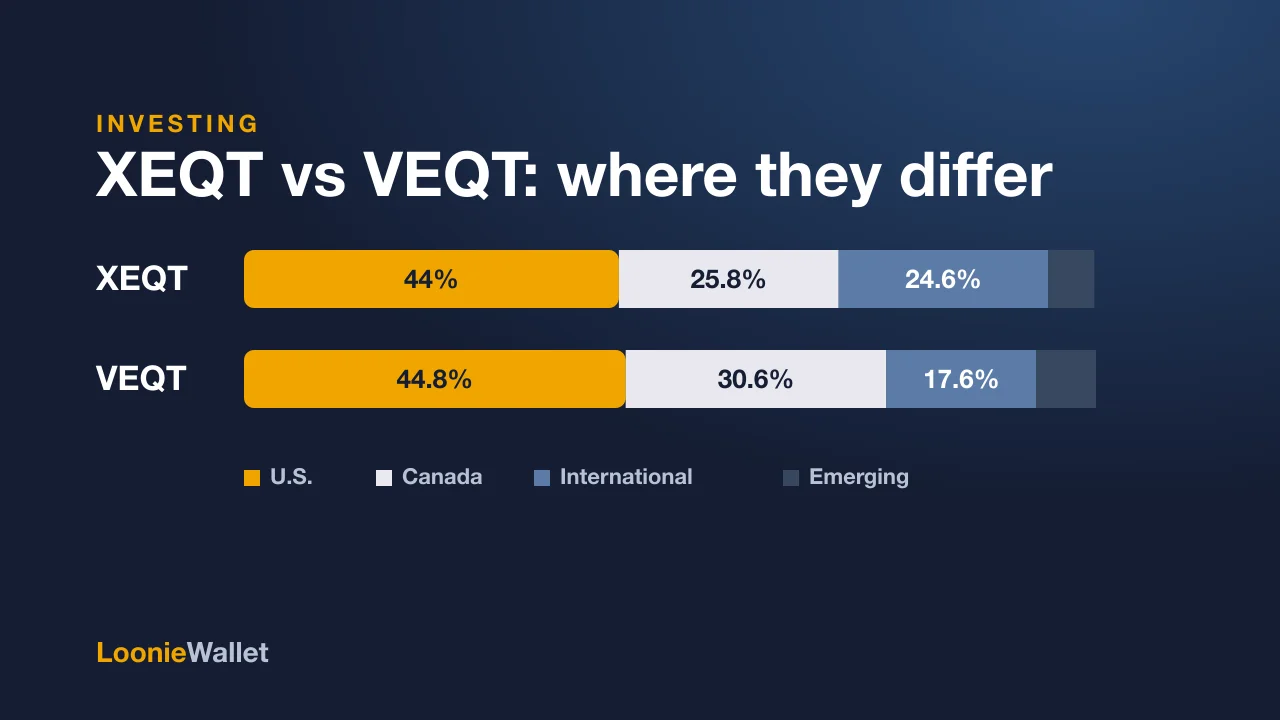
Note that this is a U.S.-dividend point only. XEQT’s international sleeve pays source-country withholding in every account, and there is no structure that avoids it for a Canadian investor.
A placement order that works
If you hold a taxable account alongside registered ones, and you want to apply rule two without redesigning your life:
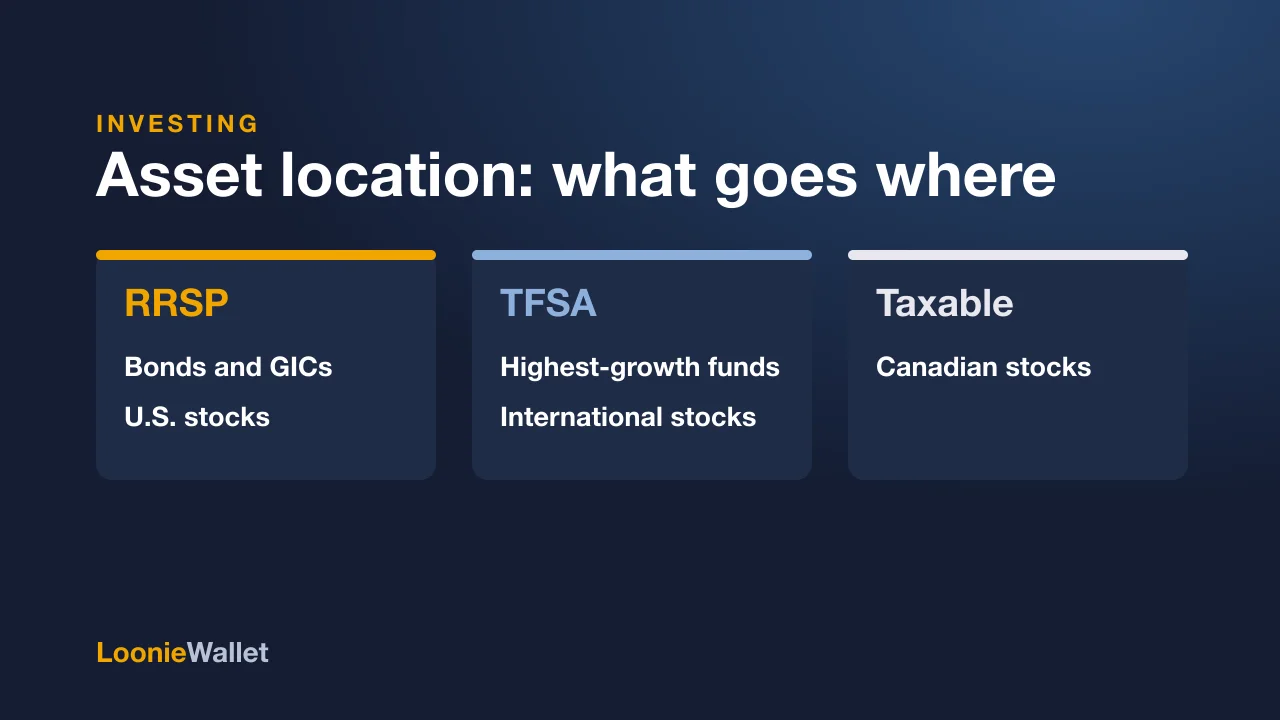
- Bonds and GICs: RRSP first, then TFSA. Interest is taxed hardest, and the RRSP is where it is sheltered longest. Many people keep their entire bond allocation inside the RRSP for this reason.
- U.S. stocks: RRSP (U.S.-listed if the balance justifies it), then taxable, then TFSA. The RRSP can be exempt; the taxable account gets a credit; the TFSA gets nothing back.
- International stocks: registered accounts, either one. Withholding is lost in both; the difference is small.
- Canadian stocks: taxable account last, which means they are the best thing to hold there. Eligible dividends and deferred capital gains are the lightest-taxed income Canada offers.
- Highest expected growth in the TFSA. Growth in a TFSA is never taxed; growth in an RRSP is taxed on the way out. If you must choose which account holds the aggressive sleeve, the TFSA’s tax-free growth is worth more than the RRSP’s.
Rule five and rule two can conflict (U.S. stocks have both high expected growth and a withholding problem in the TFSA). When they do, the withholding cost is small and certain while the growth advantage is large and uncertain; most analyses put the equity in the TFSA.
Why the simple version usually wins
Splitting asset classes across accounts means you now rebalance across accounts, track the mix yourself, and risk letting the RRSP become all bonds and the TFSA all stocks, which changes the after-tax mix in ways that are hard to see. Every study of the after-tax benefit of asset location lands in the range of a few tenths of a percent a year for a portfolio that has a substantial taxable component. That is worth having if you have a large taxable account and enjoy the bookkeeping. It is not worth an error.
The default that captures most of the benefit with none of the complexity: one all-in-one ETF per registered account, registered accounts filled before the taxable one, and in the taxable account a Canadian-heavy or global equity fund rather than bonds. Add the U.S.-listed-in-RRSP layer only when the RRSP is large.
Where this fits
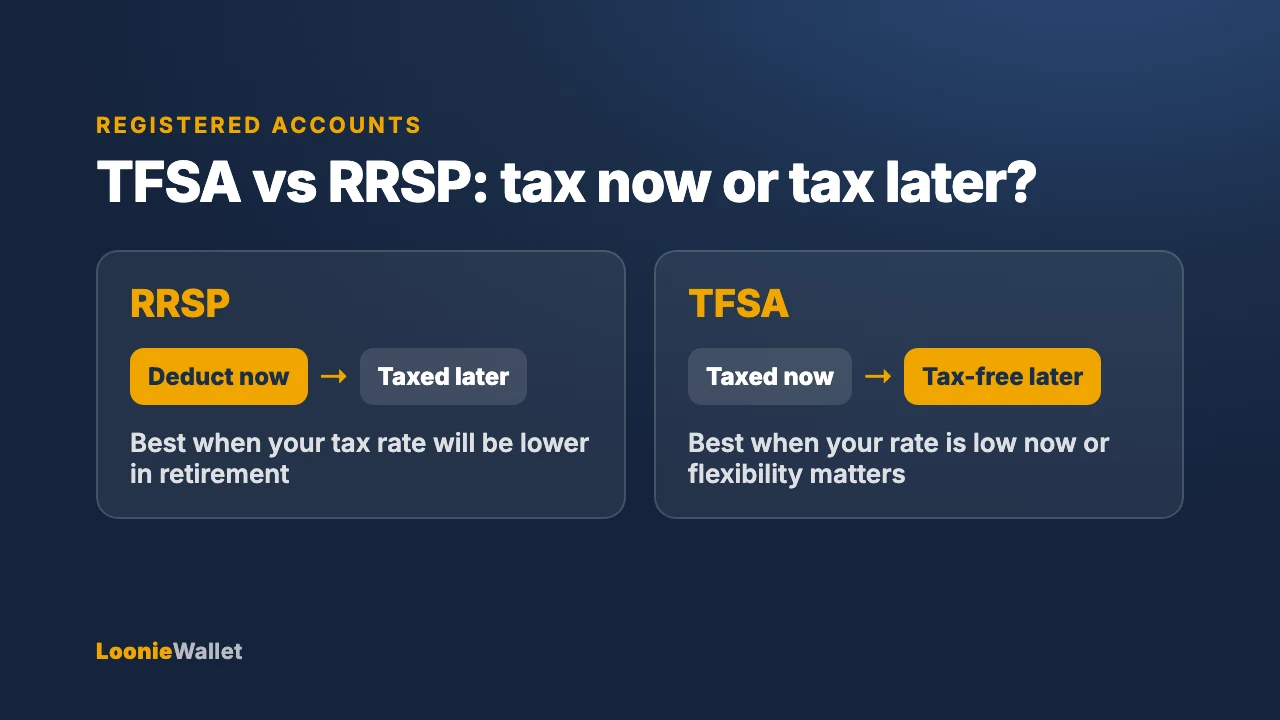
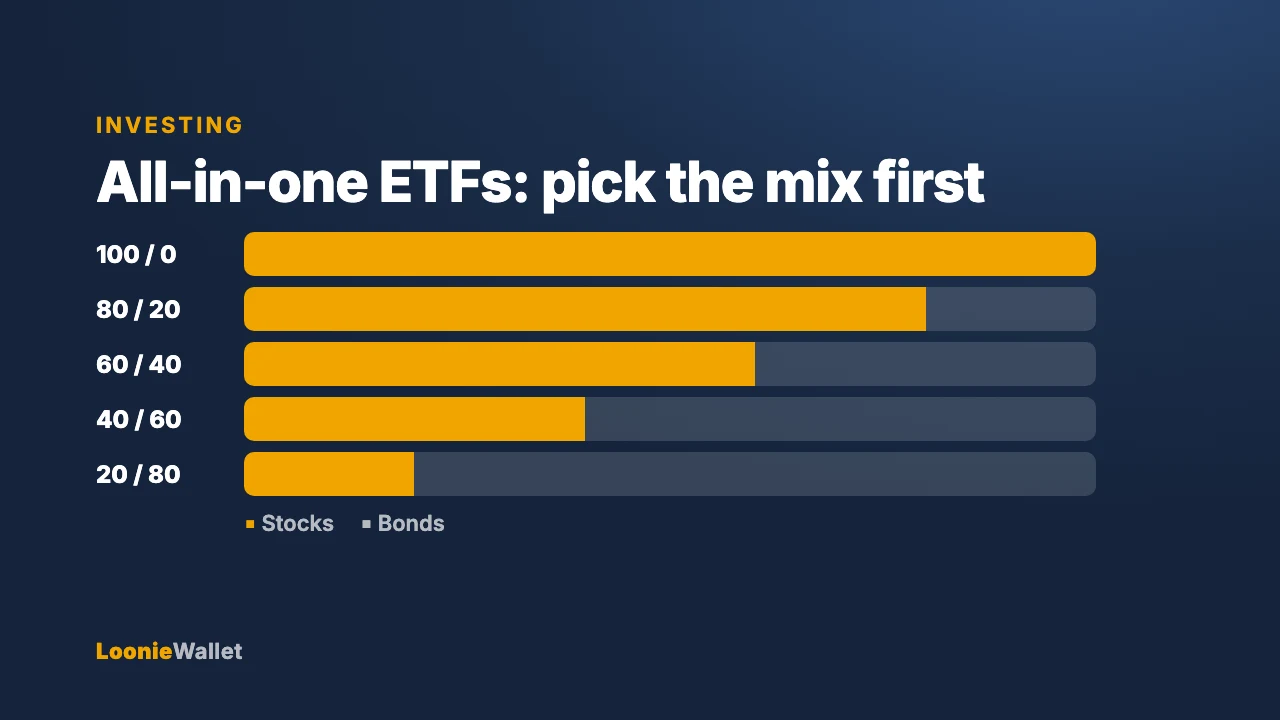
Before location, decide contribution order: the TFSA vs RRSP rule and the FHSA guide. Then the mix: the all-in-one ETF guide. The XEQT vs VEQT comparison notes that withholding treatment is identical for the two funds, which is why account choice, not fund choice, is where the tax difference lives.
Tax rules on this page were checked against CRA and issuer sources on 2026-09-18 and can change without notice. The examples use federal rates only and ignore provincial dividend credits, benefit clawbacks and the alternative minimum tax. This is education, not tax advice; a large taxable portfolio deserves a professional review.
About LoonieWallet
LoonieWallet is an independent resource created to help make smarter financial decisions. We research and publish fact-based guides, tutorials, and product reviews covering money transfers, fintech apps, and personal finance tools. Our mission is to make personal finance easier and clearer so readers can save time, money, and stress.
Read more about us here. If you have any questions, you can contact us using this page.
Sources
Checked on Sep 18, 2026 (CRA dividend gross-up and federal credit rates, capital gains inclusion rate, 2026 federal brackets; Canada–U.S. treaty withholding and account treatment per the iShares reference guide; issuer fund data).
- Lines 12000 and 12010: taxable amount of dividends from taxable Canadian corporations — Canada Revenue Agency
- Line 40425: federal dividend tax credit — Canada Revenue Agency
- Prime Minister cancels proposed capital gains tax increase (March 21, 2025) — Prime Minister of Canada
- Income tax rates and brackets for 2026 — Canada Revenue Agency
- Understanding foreign withholding tax: a reference guide — BlackRock Asset Management Canada
- Vanguard S&P 500 Index ETF (VFV) — Vanguard Investments Canada