LoonieWallet Team · Investment · Last verified
XEQT vs VFV: They Solve Different Problems
One is a whole portfolio; the other is a bet on 500 American companies, a third of it in ten stocks. Comparing them on past returns misses the point. What each one is, what happens to your U.S. weight when you hold both, and how the withholding tax treatment is the same either way.
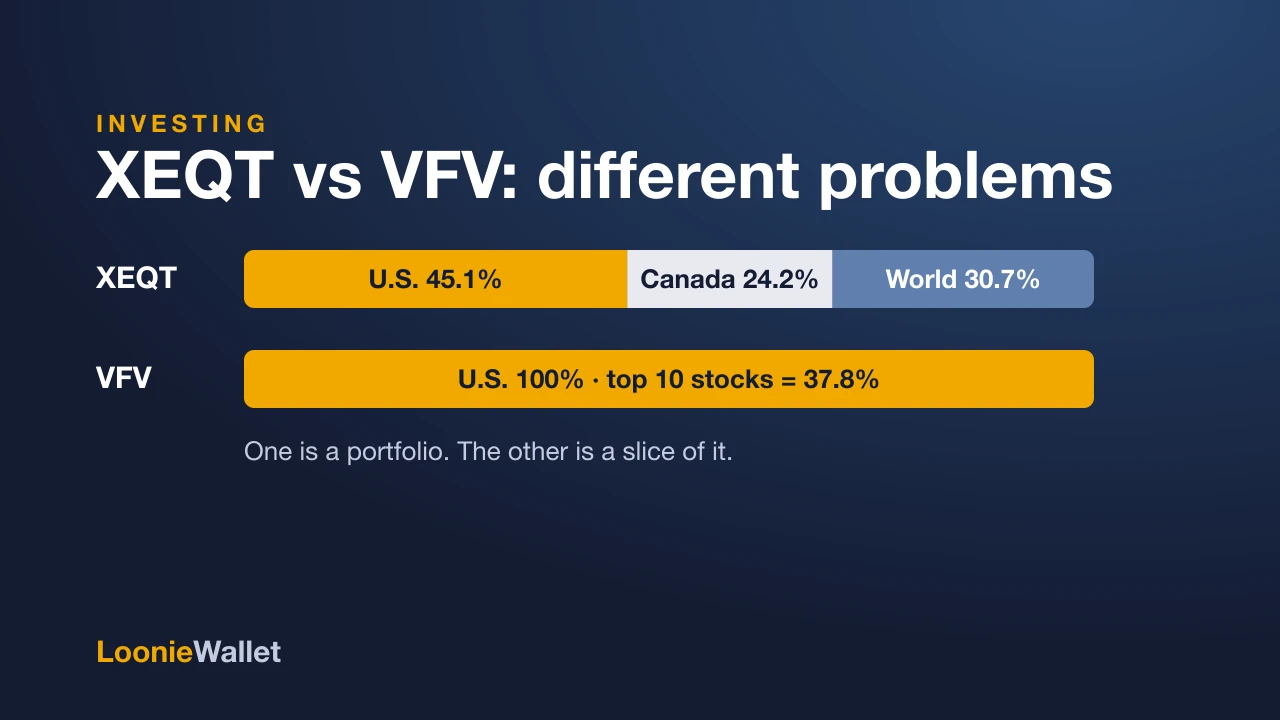
People search “XEQT vs VFV” as if choosing between two versions of the same thing. They are not. XEQT is a complete portfolio: every listed stock market in the world, 8,272 companies, rebalanced for you. VFV is the S&P 500: 500 large American companies, in one currency, with 37.8% of the money in ten of them. VFV is a slice of what XEQT already holds.
So the useful question is not “which one” but “do I want to concentrate?” This page gives you the numbers to answer it, verified from issuer documents on October 10, 2026.
What each one is
| XEQT | VFV | |
|---|---|---|
| What it holds | Global stocks: U.S. 45.1%, Canada 24.2%, developed international about 25%, emerging about 5% | The S&P 500, via the U.S.-listed Vanguard S&P 500 ETF (VOO); 100% U.S. |
| Companies | 8,272 | About 500 |
| Top 10 holdings | Roughly 17% of the fund (the same ten U.S. giants, diluted by everything else) | 37.8%; NVIDIA 8.1%, Apple 7.0%, Microsoft 5.7% |
| MER | 0.19% | 0.08% |
| Net assets | $22.1 billion | $35.2 billion |
| Trailing 12-month yield | 1.57% | 0.84% |
| Currency | Trades in CAD; holds many currencies unhedged | Trades in CAD; holds U.S. dollars unhedged |
| Distributions | Quarterly | Quarterly |
| Rebalancing | Automatic across regions | None needed; it is one index |
| Launched | 2019-08-07 | 2012-11-02 |
XEQT data as at August 31, 2026 (fact sheet) and April 30, 2026 (ETF Facts investment mix). VFV holdings and net assets as of August 31, 2026 and trailing yield as of September 30, 2026 (Vanguard product page); the top-ten weight is the sum of the listed holdings, with Alphabet’s two share classes counted separately.
Why the past-returns comparison misleads
The S&P 500 has beaten most of the world for over a decade, so VFV’s trailing returns are higher than XEQT’s over most windows. That is a fact about the period, not about the funds. XEQT holds the S&P 500 companies too; it simply also holds everything else, and everything else did worse. If the next decade looks like the last one, VFV wins again. If it looks like the 2000s, when the S&P 500 went nowhere for ten years while emerging markets and Canada did well, XEQT wins. Nobody knows which it will be, and the point of a global fund is not having to know.
Three things are true about VFV that are not true about XEQT:
- Concentration. Ten companies are 37.8% of VFV, and most of that weight is in technology. In XEQT the same ten are roughly 17% of the fund.
- One currency. Every dollar in VFV is exposed to the U.S. dollar. When the loonie strengthens, VFV falls in Canadian-dollar terms even if the S&P 500 is flat. XEQT has that exposure on about 45% of the fund and other currencies on the rest.
- One country’s rules. Tax policy, regulation and valuation cycles in one market decide the whole result.
None of that makes VFV a bad fund. It is a superb, nearly free way to own the U.S. market. It is just not a portfolio.
What happens when you hold both
Most people who ask about these two end up buying both, usually as “XEQT for diversification, VFV for growth.” That is a decision to raise your U.S. weight and your top-ten concentration; here is by how much.
| Portfolio | U.S. weight | Canada weight | Top 10 U.S. stocks |
|---|---|---|---|
| 100% XEQT | 45% | 24% | 17% |
| 90% XEQT + 10% VFV | 51% | 22% | 19% |
| 75% XEQT + 25% VFV | 59% | 18% | 22% |
| 50% XEQT + 50% VFV | 73% | 12% | 27% |
Arithmetic on the issuer weights above; the top-ten column assumes XEQT’s U.S. sleeve carries the same top-ten weight as the S&P 500, which slightly overstates it because XEQT’s U.S. funds are total-market indexes.
A 75/25 split takes you from 45% U.S. to about 59%, which is close to the U.S. share of a global market-cap index. That is a defensible position for someone who thinks XEQT’s Canadian home bias is too large. A 50/50 split puts you at about 73% U.S. with roughly 27% of the portfolio in ten companies. That is a concentrated bet, and you should make it knowing so.
If what you actually want is “less Canada, more world” rather than “more America,” the cleaner tool is a global ex-Canada fund rather than an S&P 500 fund. If what you want is to own more of the S&P 500, VFV is the right tool, and the honest label for the decision is a tilt.
Withholding tax: the same for both
A common belief is that VFV “loses” U.S. dividend withholding tax while XEQT does not, or the reverse. Neither. Per the iShares reference guide, every Canadian-listed fund that reaches U.S. stocks, whether by holding them directly, through a Canadian ETF, or through a U.S.-listed ETF, pays the 15% treaty withholding on U.S. dividends, and that applies whether you hold the fund in a TFSA, an RRSP or a taxable account. VFV (a Canadian fund holding VOO) and XEQT (a Canadian fund holding ITOT and XUU) are in exactly the same position.
What differs is the size of the dividend being taxed. VFV’s trailing yield is 0.84%, so the withholding costs about 0.13% a year in a registered account. In XEQT the U.S. sleeve is 45% of the fund, so the U.S. withholding is proportionally smaller, but XEQT also pays source-country withholding on its international sleeve (a weighted average of about 10.49% across developed markets, per BlackRock). Both drags are on the order of a tenth of a percent a year. In a taxable account both are generally creditable against Canadian tax.
The only way to avoid U.S. withholding is to hold a U.S.-listed ETF directly in an RRSP, which the treaty exempts. That involves converting currency and is worth it only for large RRSP balances; the asset location guide does the arithmetic.
Which account
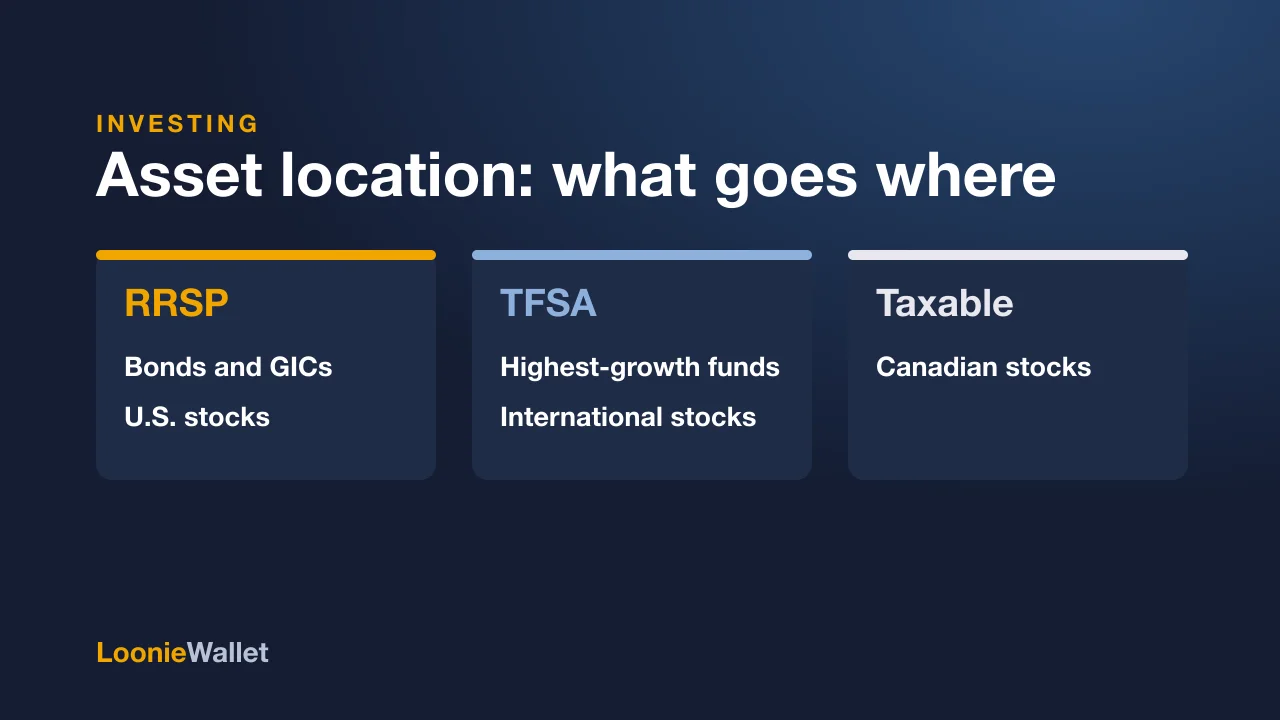
Both funds fit any account. In a taxable account, XEQT’s Canadian sleeve pays eligible dividends that receive the dividend tax credit, while VFV’s dividends are foreign income taxed at your full marginal rate. That is a mild point for XEQT in a non-registered account and irrelevant inside a TFSA or RRSP. The TFSA vs RRSP rule decides which registered account; this decision only matters after both are full.
How to decide
- Do you want a complete portfolio in one ticker? XEQT. Stop here; the all-in-one guide helps you confirm 100% equity is the right mix.
- Do you already have a diversified core and want more U.S. large-cap exposure on purpose? Add VFV, and use the blend table to see what weight you are choosing.
- Do you want the S&P 500 and only the S&P 500? VFV, knowing that you hold one country, one currency and a top-heavy index.
- Are you buying VFV because it went up more? That is the one reason that does not hold up. The premium the U.S. market commands over the rest of the world is already in the price.
Figures are from issuer documents as of the dates shown, reflect the time of writing, and can change without notice. Confirm current figures on the issuer’s website before you buy. This is education, not a recommendation to buy either fund.
About LoonieWallet
LoonieWallet is an independent resource created to help make smarter financial decisions. We research and publish fact-based guides, tutorials, and product reviews covering money transfers, fintech apps, and personal finance tools. Our mission is to make personal finance easier and clearer so readers can save time, money, and stress.
Read more about us here. If you have any questions, you can contact us using this page.
Sources
Checked on Oct 10, 2026 (iShares XEQT fact sheet (August 2026) and ETF Facts (June 2026); Vanguard VFV product page (holdings as of August 31, 2026; trailing yield as of September 30, 2026); withholding tax treatment per the iShares reference guide).
- iShares Core Equity ETF Portfolio (XEQT) fact sheet, August 2026 — BlackRock Asset Management Canada
- XEQT ETF Facts, June 19, 2026 — BlackRock Asset Management Canada
- Vanguard S&P 500 Index ETF (VFV) — Vanguard Investments Canada
- Understanding foreign withholding tax: a reference guide — BlackRock Asset Management Canada