LoonieWallet Team · Investment · Last verified
RRSP Complete Guide: How it Works
Learn how RRSPs work in Canada, contribution limits, and how to maximize your tax savings as a newcomer or young professional.

Introduction: Why RRSPs Matter Even When Retirement Feels Far Away
Even if retirement feels far away, a Registered Retirement Savings Plan (RRSP) can save you thousands in taxes today while preparing for the future.
Here’s something most people don’t realize until tax season hits: contributing to an RRSP doesn’t just help future you—it puts money back in your pocket right now. That $5,000 you contribute could reduce your tax bill by $1,500 or more, depending on your income. That’s not retirement money you’ll see in 40 years—that’s cash you get back in your next refund.
But RRSPs can be confusing, especially when everyone also tells you to open a TFSA. If you’re a newcomer to Canada or just starting your career, the tax terminology alone can feel overwhelming. This guide breaks down exactly how RRSPs work, when they make sense for you, and how to avoid the mistakes that cost Canadians thousands every year.
What Exactly Is an RRSP?
A Registered Retirement Savings Plan is a government-registered account designed to help Canadians save for retirement while getting tax breaks along the way. Think of it as a deal with the CRA: they let you skip paying taxes on the money you contribute now, it grows tax-free inside the account, and you pay tax on it later when you withdraw during retirement (when you’re presumably in a lower tax bracket).
Here’s how it works in practice: Let’s say you earn $60,000 and contribute $5,000 to your RRSP. When you file your taxes, your taxable income drops to $55,000. Depending on your province, that could mean $1,500+ back in your pocket. That contribution didn’t cost you $5,000—it cost you more like $3,500 after the tax refund.
The real magic happens inside the account. Just like a TFSA, you can hold various investments in your RRSP—stocks, bonds, ETFs, mutual funds, GICs, even high-interest savings. All the growth, dividends, and interest accumulate without any tax consequences until you eventually withdraw the money.
Who Should Have an RRSP?
RRSPs tend to be more beneficial when:
- You earn $50,000+ annually (higher tax brackets benefit most)
- You’ve maxed out your TFSA or have room for both
- You’re focused specifically on retirement savings
- You’re comfortable not touching the money until retirement
- You want to reduce your current tax bill
You might want to prioritize a TFSA first if:
- You’re in a low tax bracket (under $50,000)
- You’re saving for non-retirement goals (home, travel, emergency fund)
- You’re still figuring out your career path
- You want maximum flexibility with withdrawals
RRSP vs TFSA: The Complete Comparison
For the full decision framework with 2026 numbers at four income levels, read TFSA vs RRSP: which should you fund first?. The table below is the quick reference.
| Feature | TFSA | RRSP |
|---|---|---|
| Tax on Contributions | Already taxed (no deduction) | Deductible from income (immediate tax savings) |
| Tax on Withdrawals | Tax-free | Taxed as income |
| Contribution Room | $7,000 annually (2026) | 18% of previous year's earned income, up to $33,810 (2026) |
| Withdrawal Flexibility | Anytime, no penalty | Early withdrawals taxed + withholding tax |
| Contribution Room After Withdrawal | Returns next year | Lost forever (except HBP/LLP) |
| Impact on Government Benefits | None | Withdrawals can reduce OAS, GIS |
| Ideal For | Flexible savings/investing, all goals | Retirement & tax planning for higher earners |
The Math That Makes the Difference
Let’s compare two identical scenarios:
Scenario A - TFSA:
- You earn $70,000 and want to save $10,000
- You pay tax on your full income
- You contribute $10,000 after-tax dollars to your TFSA
- It grows to $50,000 over 20 years
- You withdraw $50,000 tax-free
Scenario B - RRSP:
- You earn $70,000 and contribute $10,000 to your RRSP
- Your taxable income drops to $60,000 (you save roughly $3,000 in taxes)
- That $10,000 grows to $50,000 over 20 years
- You withdraw it in retirement when you’re in a lower bracket (say 20% instead of 30%)
- You pay $10,000 in tax, keeping $40,000
Wait—that sounds worse, right? Here’s the key: you also got that $3,000 tax refund upfront. If you invested that refund too, you’d actually come out ahead. Plus, most people are in lower tax brackets during retirement, making the math even better.
Many Canadians use a combination of both, depending on their goals. RRSP for retirement and tax savings, TFSA for everything else.
RRSP Contribution Limits (2026)
Understanding contribution limits is critical. Unlike TFSAs which have a fixed annual limit, your RRSP room depends on your income.
Annual Limit Formula
18% of your previous year's earned income, up to a maximum of $33,810 for 2026, minus any pension adjustment
Carry Forward
Unused contribution room carries forward indefinitely—you never lose it
Source: CRA RRSP dollar limits, verified 2026-09-18.
How RRSP Contribution Room Actually Works
Here’s a real example: You earned $55,000 in 2025. Your 2026 RRSP contribution room would be 18% of $55,000 = $9,900, plus any unused room from previous years.
If you started your first job in 2025 and earned $45,000, you’d have $8,100 in RRSP room for 2026 (18% of $45,000). But if you don’t contribute anything in 2026, that $8,100 carries forward. In 2027, if you earned $50,000 in 2026, you’d have $8,100 + $9,000 = $17,100 available.
Important deadline: You have until 60 days after the end of the year to make contributions that count against that year’s taxes. Contributions made by March 1, 2027 can be deducted on your 2026 return.
Check your room: Don’t guess your contribution limit. Log into your CRA My Account to see your exact available room. Your Notice of Assessment also shows this amount.
What Counts Toward Your RRSP Limit?
- Your personal contributions
- Employer contributions (if you have a group RRSP)
- Spouse or partner contributions to a spousal RRSP on your behalf
What doesn’t reduce your room:
- Investment growth inside your RRSP
- Transfers from another RRSP
Advantages of an RRSP
Immediate Tax Deduction
Contributions reduce your taxable income today. Get a refund this year, not in 30 years.
Tax-Deferred Growth
Investments grow tax-free until withdrawal. No capital gains tax on trades inside your RRSP.
Retirement Security
Builds long-term wealth systematically. Forces you to save by making early withdrawals costly.
Beyond the Basics: Hidden RRSP Benefits
Income splitting with a spousal RRSP: If you earn significantly more than your spouse, you can contribute to a spousal RRSP in their name. You get the tax deduction at your higher rate, but they withdraw it later at their lower rate. This is one of the best legal tax strategies available.
Protection from creditors: In most provinces, RRSPs are protected from creditors if you declare bankruptcy (except for contributions made in the 12 months before bankruptcy). This doesn’t apply to TFSAs.
Home Buyers’ Plan (HBP): First-time homebuyers can withdraw up to $60,000 from their RRSP for a down payment, tax-free. You have 15 years to pay it back. This is basically an interest-free loan from yourself.
Lifelong Learning Plan (LLP): Withdraw up to $10,000 per year (max $20,000 total) to fund full-time education for you or your spouse. Again, you repay it over 10 years.
Common RRSP Mistakes to Avoid
Even seasoned Canadians mess these up. Here’s what to watch for:
1. Contributing When You’re in a Low Tax Bracket
If you earn $35,000, your RRSP deduction saves you maybe 20% in taxes. But if you withdraw that money in retirement when you’re still at 20%, you gained nothing. The RRSP only works when you contribute at a high tax rate and withdraw at a low rate. Focus on your TFSA first if you’re early in your career.
2. Not Maximizing Employer Matching
If your employer matches RRSP contributions, that’s free money—sometimes 50-100% returns immediately. If they match up to 5% and you only contribute 3%, you’re leaving money on the table. Always contribute at least enough to get the full match.
3. Withdrawing Early for Non-Emergencies
When you withdraw from an RRSP (outside HBP or LLP), three things happen:
- You pay immediate withholding tax (10-30% depending on amount)
- That money gets added to your income, potentially pushing you into a higher bracket
- You permanently lose that contribution room
A $10,000 withdrawal could cost you $3,000+ in taxes, and you can never put that $10,000 back. This is why RRSPs are for long-term goals only.
4. Forgetting to Claim Your Deduction
Here’s a strategy many miss: you can contribute to your RRSP but delay claiming the deduction. Why? If you’re in a low bracket now but expect higher income soon (promotion, career change), contribute today but claim the deduction next year when it’s worth more. Your contribution room gets used, but you save the tax benefit for later. Filing with software such as Wealthsimple Tax makes it easy to carry a deduction forward.
5. Overcontributing
You get a lifetime cushion of $2,000 over your deduction limit for honest mistakes. Anything beyond that is taxed at 1% per month on the excess until you withdraw it, and you must file form T1-OVP within 90 days of year-end. With your Notice of Assessment in hand, this should never happen—but it does, especially with employer contributions people forget to track. If you are over, here is how to fix it.
The Home Buyers’ Plan (HBP): Using Your RRSP to Buy a Home
This deserves its own section because it’s one of the most useful RRSP features for young Canadians. If you have not bought yet, read the FHSA guide first: the First Home Savings Account gives the same deduction with no repayment, and it can be combined with the HBP on the same purchase. The two are compared head to head in FHSA vs Home Buyers’ Plan.
How the HBP Works
If you’re a first-time homebuyer (defined as not having lived in a home you or your spouse owned in the last 4 years), you can withdraw up to $60,000 from your RRSP tax-free to use as a down payment. Your spouse can also withdraw $60,000, meaning a couple could access $120,000 combined. The limit rose from $35,000 to $60,000 for withdrawals made after April 16, 2024.
The catch? You must repay 1/15th of the amount each year for 15 years. Repayments normally start in the second year after the withdrawal, but for withdrawals made between 2022 and 2028 the CRA has deferred the start to the fifth year. Miss a payment and the CRA adds that year’s minimum to your income. Full rules: CRA Home Buyers’ Plan.
HBP Strategy
Here’s a smart approach many use:
- Contribute to your RRSP when you’re in a high tax bracket
- Get the tax refund (say $2,500 on a $10,000 contribution)
- Wait 90 days (required holding period)
- Withdraw that $10,000 for your home purchase via HBP
- Repay it slowly over 15 years, essentially having reduced your down payment cost by $2,500
This works best if you’re already planning to buy within 1-2 years and would be contributing to an RRSP anyway.
How to Open and Manage Your RRSP
Step 1: Choose Your Account Type
Self-directed RRSP: You pick the investments (stocks, ETFs, bonds). Best for hands-on investors comfortable making decisions. Available through Questrade, Wealthsimple Trade, and most banks.
Managed RRSP: A robo-advisor or professional picks investments for you based on a questionnaire. Good for beginners. Check out Wealthsimple, Questwealth, or BMO SmartFolio.
Group RRSP: Through your employer. Often comes with matching contributions. Always participate if matching is offered.
Mutual fund RRSP: Through banks, usually higher fees. Not recommended unless you’re getting financial advice that justifies the cost.
Step 2: Pick Your Investments
Your RRSP isn’t an investment—it’s an account that holds investments. Inside your RRSP, you might have:
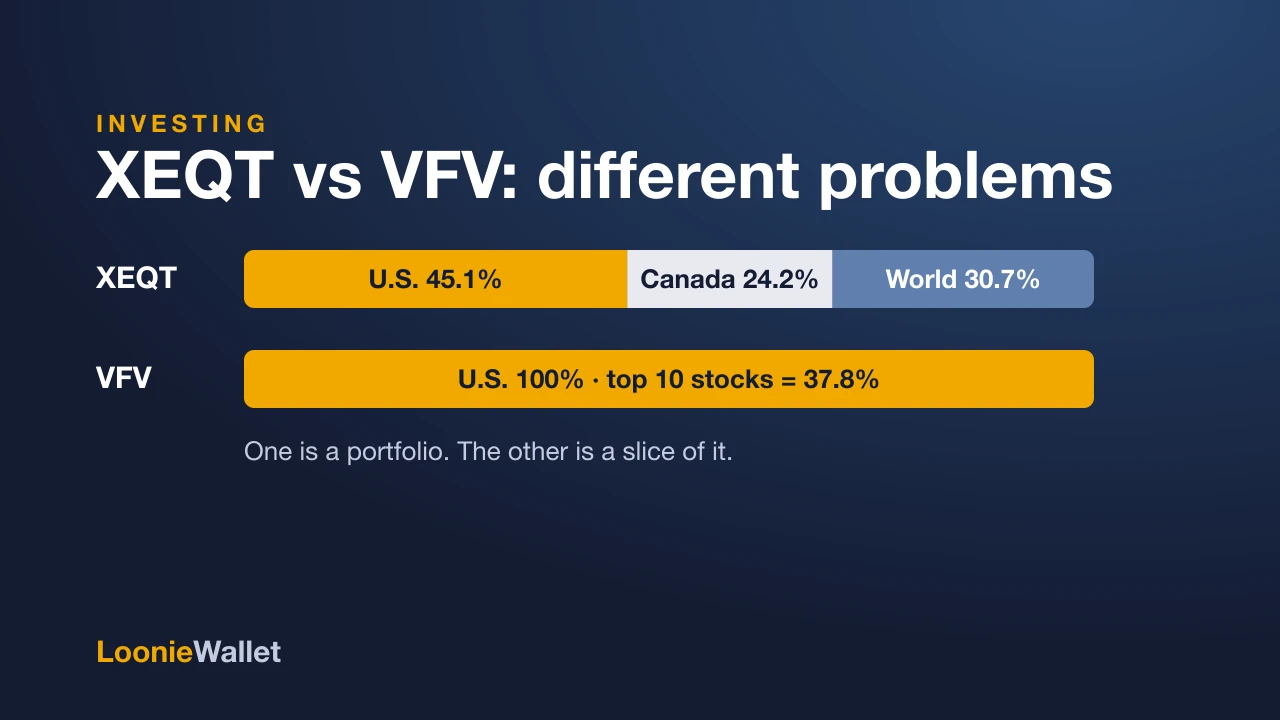
- ETFs (Exchange Traded Funds): Low-cost, diversified. Great for most people. Popular choices include VGRO, XEQT, or VFV; our all-in-one ETF guide compares them, and asset location covers why U.S.-listed funds can make sense in an RRSP specifically.
- Mutual funds: Higher fees but professionally managed. Only worth it with employer plans that subsidize costs.
- GICs: Guaranteed returns, very safe. Good for money you’ll need within 5 years or if you can’t stomach volatility.
- Individual stocks: Higher risk, requires research. Only if you know what you’re doing.
- High-interest savings: Safe parking spot while you decide where to invest.
If you’re decades from retirement - some experts suggest higher equity allocations for younger investors, though the right mix depends on your comfort with risk.
Step 3: Automate Your Contributions
Set up automatic monthly contributions. Even $200/month = $2,400/year, which could save you $500-800 in taxes while building your retirement fund. You’ll adjust to the reduced take-home pay within a month or two.
RRSP Strategies by Income Level
Earning $30,000 - $50,000
Focus on your TFSA first. Your tax bracket is relatively low, so the RRSP deduction isn’t as valuable. Exception: if your employer offers matching, contribute at least enough to get the full match.
Earning $50,000 - $80,000
This is the sweet spot where RRSPs start making sense. Consider splitting between TFSA and RRSP, or prioritize RRSP if you’re in the 30%+ marginal bracket. Max your TFSA first if you’re planning to buy a home soon.
Earning $80,000+
High earners often prioritize RRSP contributions for the tax savings. You’re in a high enough bracket that the tax savings are substantial. If you max out your RRSP and TFSA, consider spousal RRSPs for income splitting or non-registered investment accounts.
For Newcomers to Canada
You don’t earn RRSP contribution room until you file a Canadian tax return. Your first year in Canada, focus on opening a TFSA and building your credit. Starting in year two, you’ll begin accumulating RRSP room based on your Canadian income.
What Happens to Your RRSP at Age 71?
By December 31st of the year you turn 71, you must convert your RRSP into either:
RRIF (Registered Retirement Income Fund): The most common choice. You’re forced to withdraw a minimum percentage each year, which gets taxed as income.
Annuity: An insurance company pays you a fixed amount for life. Less common these days.
Lump sum withdrawal: You cash everything out and pay tax on the entire amount. Almost never a good idea unless the account is small.
Most people choose the RRIF option since it maintains tax-deferred growth while forcing you to gradually draw down the account.
RRSP vs Pension: How They Work Together
If you have a workplace pension (defined benefit or defined contribution), it affects your RRSP contribution room. The pension adjustment (PA) reduces your available RRSP room because you’re already building retirement savings through your pension.
For example, if your pension contribution is deemed worth $8,000 by the CRA, that $8,000 reduces your RRSP limit. Check your T4 slip for your PA amount—it’s reported there annually.
Having both is ideal: maximize what your employer pension offers, then use RRSP room for additional savings.
Real-World RRSP Example
Meet Sarah: 28 years old, earns $65,000, works in Toronto. She has $15,000 in TFSA (maxed), no debt, and $500/month extra to save.
Her strategy:
- Contributes $6,000/year to RRSP ($500/month)
- Gets roughly $1,800 back in tax refunds
- Puts that refund into her TFSA
- Invests RRSP in 90% stocks/10% bonds (long timeline)
- Plans to use HBP in 3 years when buying a condo
Result after 3 years:
- RRSP: $20,000+ (contributions + growth)
- Tax savings: $5,400 (over 3 years)
- Can withdraw up to $20,000 via HBP for down payment
- Net cost of that $20,000 down payment: only $14,600 after tax savings
She’s built a down payment while paying less out of pocket, thanks to the RRSP deduction.
Next Steps: Open Your RRSP and Start Saving Smartly
If RRSPs make sense for your situation, there’s no reason to delay. Every year you wait is a year of potential tax savings lost. Even starting with $100/month builds momentum and establishes the habit.
Remember: personal finance is called “personal” for a reason. What works for your coworker or sister might not work for you. Consider your income, goals, timeline, and comfort with risk.
Ready to get started?
Low-fee investment platforms: Invest with Wealthsimple | Invest with Questrade
Still deciding between RRSP and TFSA? Read the TFSA guide
The best RRSP strategy is the one you’ll actually stick with. Start small, stay consistent, and adjust as your income grows. Your 65-year-old self is counting on the decisions you make today.
Disclaimer: This content is for educational purposes only and is not intended as financial, investment, or tax advice. Please consult a licensed financial advisor or tax professional for advice specific to your situation. Limits, rates and rules on this page are as of the time of writing and can change without notice; confirm current figures with the CRA before you act.
About LoonieWallet
LoonieWallet is an independent resource created to help make smarter financial decisions. We research and publish fact-based guides, tutorials, and product reviews covering money transfers, fintech apps, and personal finance tools. Our mission is to make personal finance easier and clearer so readers can save time, money, and stress.
Read more about us here. If you have any questions, you can contact us using this page.
Sources
Checked on Sep 18, 2026 (CRA 2026 RRSP and TFSA dollar limits, contribution deadline, Home Buyers' Plan limit and repayment rules).
- RRSP and TFSA dollar limits by year (MP, DB, RRSP, DPSP, ALDA, TFSA limits and the YMPE) — Canada Revenue Agency
- What is the Home Buyers' Plan (HBP)? — Canada Revenue Agency
- RRSPs and related plans — Canada Revenue Agency