LoonieWallet Team · Investment · Last verified
RRSP Overcontribution: The $2,000 Buffer, Penalties, and How to Fix It
You get a lifetime $2,000 cushion above your RRSP deduction limit. Beyond it, the CRA charges 1% a month and expects a T1-OVP within 90 days of year-end. Here is how to tell if you are over, what it costs, and the forms that get the money out without withholding tax.
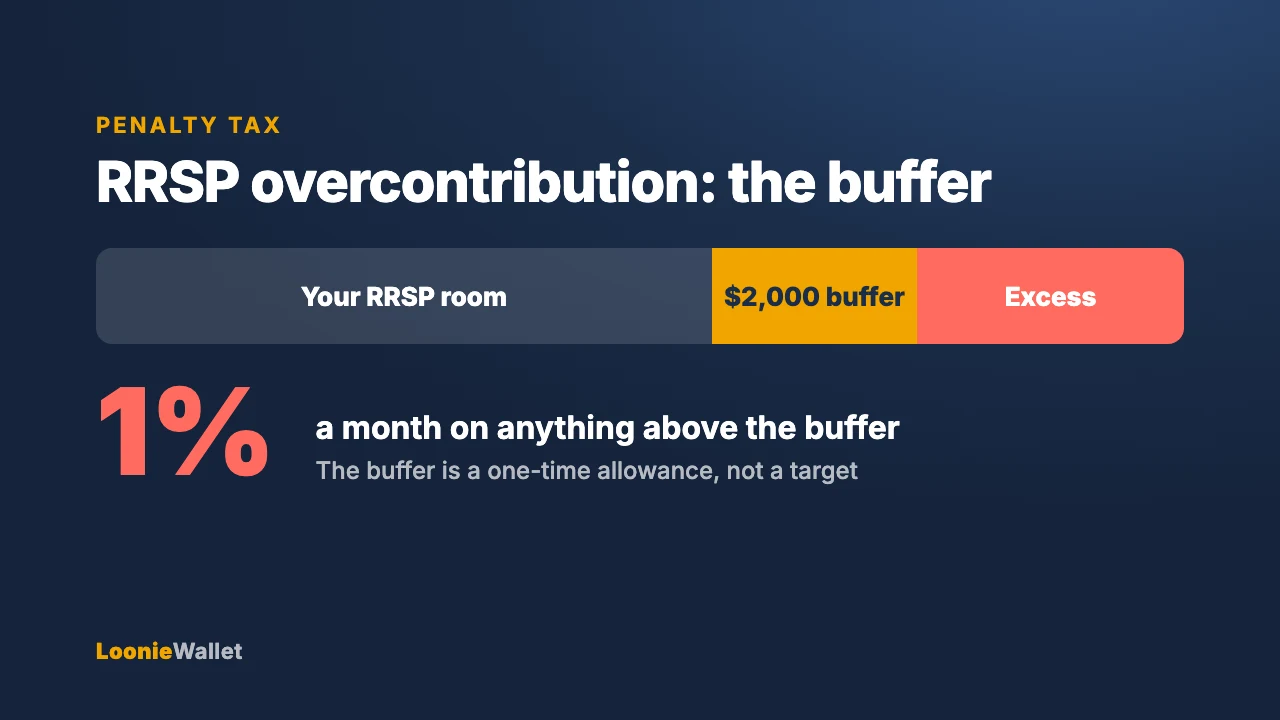
An RRSP overcontribution is less urgent than a TFSA one, because the CRA gives you a lifetime cushion of $2,000 above your deduction limit before any tax applies. Above the cushion, the rules are strict: 1% a month on the excess, a separate return due within 90 days of year-end, and a late-filing penalty on top if you miss it. This page shows how to tell whether you are over, what it costs, and how to get the money out cleanly.
Are you actually over?
Your Notice of Assessment shows two numbers that people confuse.
- RRSP deduction limit for the year: new room (18% of last year’s earned income, to a maximum of $33,810 for 2026, minus any pension adjustment) plus unused room carried forward.
- Unused RRSP contributions: money you have already put in but not yet deducted.
You have excess contributions if your unused contributions from prior years plus this year’s contributions exceed your deduction limit by more than $2,000 (the cushion applies if you were 18 or older at any time in the prior year). Contributions in the first 60 days of a year count toward the previous year’s deduction but are still contributions in the year they are made for this test, which is where many people slip.
A group RRSP is the classic trap: employer contributions count against your room, the deduction limit on the NOA already reflects last year’s pension adjustment, and payroll keeps contributing whether or not you have room left.
What it costs
Excess above the cushion is taxed at 1% per month for every month it stays in the plan. An overcontribution of $7,000 is $5,000 over the cushion: $50 a month, $600 a year, until it is withdrawn or absorbed by new room in January.
Estimate the RRSP excess tax
Want to check a TFSA or FHSA too? Use the full overcontribution penalty calculator.
One exception: if you withdraw the excess before the end of the month in which you contributed it, no tax applies for that month.
The return: T1-OVP, due 90 days after year-end
If you owe the 1% tax for any month of a year, you file a T1-OVP (Individual Tax Return for RRSP, PRPP and SPP Excess Contributions) and pay the tax no later than 90 days after the end of that year. For an excess in 2026, that is March 31, 2027. It is not part of your regular return and the deadline is earlier.
Miss it and the CRA adds a late-filing penalty of 5% of the balance owing plus 1% for each month the return is late, up to 12 months, plus interest. On $600 of tax filed six months late that is $66 more, small in dollars but a second problem you do not need.
Getting the money out without paying tax twice
An RRSP withdrawal normally has withholding tax taken off (10% to 30% outside Quebec) and is added to your income. Two forms exist so that removing an overcontribution does not cost you that:
- Form T3012A, Tax Deduction Waiver on the Refund of your Unused RRSP Contributions. You file it with the CRA before the withdrawal; once approved, your issuer refunds the unused contribution without withholding tax.
- Form T746, Calculating Your Deduction for Refund of Unused RRSP Contributions. You file it with your tax return for the year of the withdrawal. It lets you deduct the refunded amount, offsetting the income inclusion, whether or not you used a T3012A.
Practical sequence: if the excess is large and the tax is accruing, withdraw first (with withholding) and claim the offsetting deduction on a T746; if you have time, file the T3012A first and avoid the withholding altogether. Either way the excess stops accruing the 1% tax when it leaves the plan.
Two alternatives to withdrawing. If the excess is only slightly above the cushion and January is close, new room may absorb it; run the estimator on the remaining months. And if the excess came from contributions you have not deducted, you do not have to withdraw it to keep deducting: unused contributions can be deducted in a later year once you have room, but the 1% tax runs on the part above the cushion until then.
Asking for relief
The CRA can waive or cancel the 1% tax if the excess arose from a reasonable error and you are taking, or have taken, reasonable steps to eliminate it. The request goes on Form RC2503, with an explanation and the dates. As with TFSAs, the request is strongest when you withdrew the excess as soon as you found it and it has not happened before.
How people end up over the limit
- Group RRSP plus personal contributions. Payroll contributions and employer matches use room too.
- Reading “deduction limit” as “how much I can add”. The limit already counts your carried-forward unused contributions against it.
- First-60-days confusion. A February contribution claimed on last year’s return also uses room now.
- A pension adjustment you did not expect. Joining a defined-benefit or defined-contribution plan cuts the next year’s new room sharply.
- Spousal RRSP contributions. They use the contributor’s room, not the spouse’s.
- Retiring allowances and transfers handled as ordinary contributions instead of designated transfers.
Preventing it
Before every contribution, take the deduction limit from your latest NOA, subtract unused contributions already in the plan and anything payroll will add before year-end, and contribute up to that figure. Our RRSP tax refund calculator includes a room check that flags a contribution above your available room, and the RRSP guide explains how room is calculated.
This article is for education, not tax advice. Overcontribution cases involving pension adjustments, spousal plans, or several years of excess are worth a professional’s review before you file. Limits, rates and rules on this page are as of the time of writing and can change without notice; confirm current figures with the CRA before you act.
About LoonieWallet
LoonieWallet is an independent resource created to help make smarter financial decisions. We research and publish fact-based guides, tutorials, and product reviews covering money transfers, fintech apps, and personal finance tools. Our mission is to make personal finance easier and clearer so readers can save time, money, and stress.
Read more about us here. If you have any questions, you can contact us using this page.
Sources
Checked on Sep 18, 2026 (CRA RRSP excess contribution rules, $2,000 allowance, 1% tax, T1-OVP deadline and late-filing penalty, RC2503 relief, T3012A and T746 forms, 2026 RRSP limit).
- What happens if you go over your RRSP deduction limit — Canada Revenue Agency
- T1-OVP Individual Tax Return for RRSP, PRPP and SPP Excess Contributions — Canada Revenue Agency
- T3012A Tax Deduction Waiver on the Refund of your Unused RRSP, PRPP, or SPP Contributions — Canada Revenue Agency
- T746 Calculating Your Deduction for Refund of Unused RRSP, PRPP, and SPP Contributions — Canada Revenue Agency
- MP, DB, RRSP, DPSP, ALDA, TFSA limits and the YMPE — Canada Revenue Agency