LoonieWallet Team · Investment · Last verified
TFSA Overcontribution: Penalties, Examples, and What to Do Today
The CRA charges 1% a month on the highest excess in your TFSA. Here is how people end up over the limit, what it costs, the exact steps and deadline to fix it, and how to ask for the penalty to be waived.
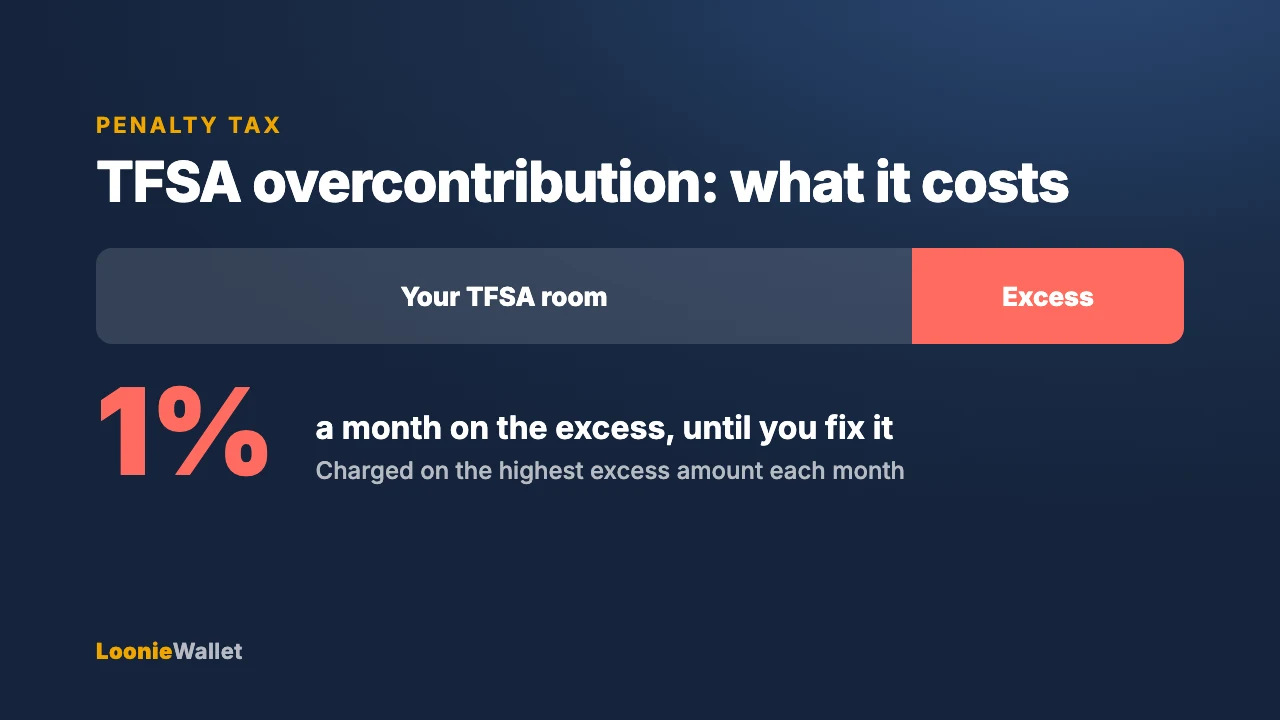
If you have put more into your TFSA than your room allows, the clock is running. The CRA taxes the highest excess amount in each month at 1%, and a single day over in a month counts as the whole month. The fix is to withdraw the excess now, then deal with the paperwork. This page covers both, in that order.
What to do today
- Work out the excess. Add up every contribution you made this year at every institution, subtract this year’s room (your unused room from prior years, plus $7,000 for 2026, plus any withdrawals you made last year). Do not rely on the figure in CRA My Account: the CRA says it is updated only once a year, in spring, with the previous year’s transactions.
- Withdraw the excess immediately. Take it out of whichever TFSA is easiest. Withdrawing this month stops next month’s 1%. Do not wait for January 1 on the theory that new room will absorb it; every month until then is taxed.
- Do not move it to another TFSA. A withdrawal and a re-deposit is two transactions, and the deposit is a new contribution. Only a direct transfer between issuers avoids that, and a direct transfer does not reduce an excess.
- File the return and pay the tax by June 30 of next year (see below), unless the excess was small enough that no tax is owed.
- Ask for a waiver if it was an honest mistake and you fixed it as soon as you found out.
How the penalty works
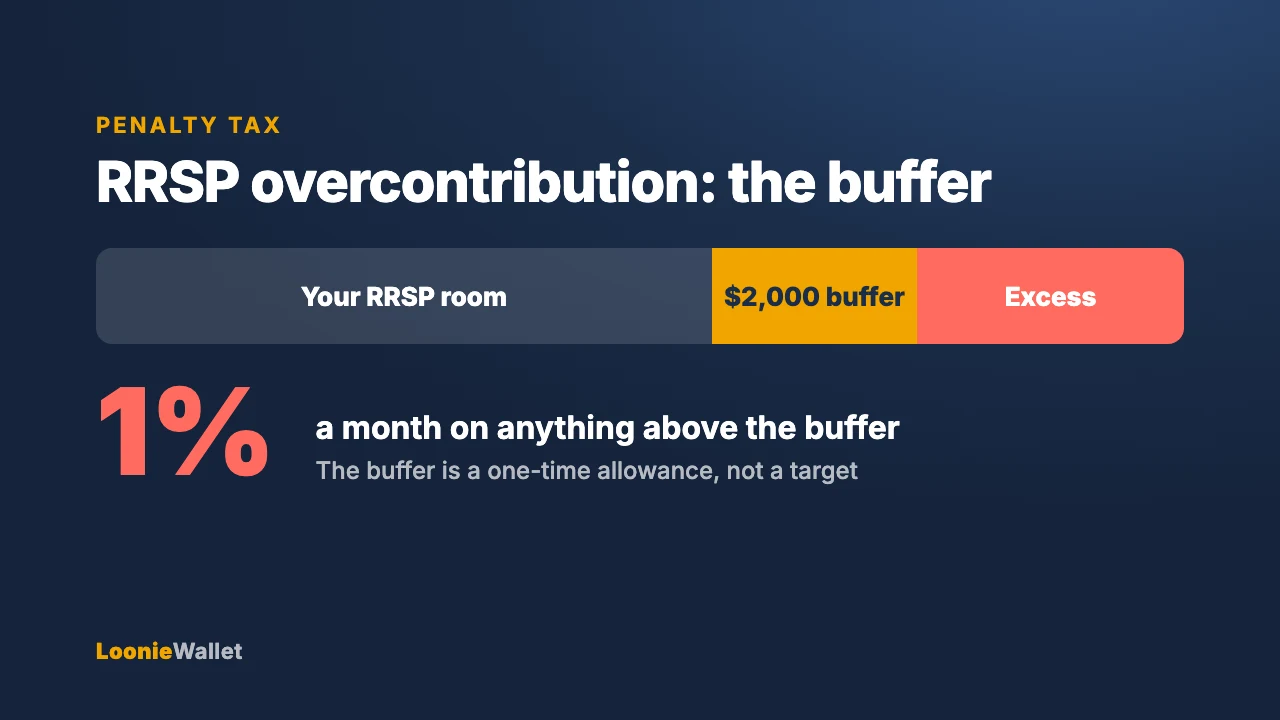
The tax is 1% per month of the highest excess amount in the month. It is not prorated for days, and it continues until the excess is gone, either through a withdrawal or through new room on January 1.
Estimate the TFSA excess tax
Want to check an RRSP or FHSA too? Use the full overcontribution penalty calculator.
Three examples, all using 2026 room of $7,000 and no prior unused room:
- The same-year recontribution. You contribute $7,000 in January, withdraw $5,000 in July for a car repair, and put $5,000 back in October. The October deposit is a new contribution; withdrawals do not restore room until the following January. Excess: $5,000 for October, November, and December. Tax: $50 × 3 = $150.
- Two institutions. You open a TFSA at your bank and another at a brokerage and put $7,000 in each. Excess: $7,000 from the month of the second deposit. Left until you notice in the spring when the CRA writes to you: $70 × about 8 months = $560, and the excess is still there.
- Room miscounted. You believe you have $20,000 of carried room and contribute $27,000 in February. Your actual carried room was $12,000. Excess: $8,000 from February. If you catch it in March and withdraw: $80 × 2 = $160.
The return: Form RC243, due June 30
If you had an excess amount at any point in a year, you file a TFSA Return (Form RC243) with Schedule A for that year by June 30 of the following year, and pay the tax with it. An excess in 2026 means an RC243 due June 30, 2027. The CRA also mails proposed TFSA returns to people whose issuer data shows an excess; if the letter’s numbers are wrong (a transfer recorded as a contribution, for instance), respond with your records rather than paying.
Asking the CRA to waive the tax
The CRA can waive or cancel all or part of the tax if it is fair to do so. It considers whether the excess arose from a reasonable error and the extent to which you withdrew the excess to correct it. The Income Tax Act’s own wording is that the tax may be waived where the liability arose because of reasonable error and the individual arranged, without delay, for the excess to be withdrawn.
To request it, send a letter explaining why the excess happened and why waiving the tax is fair, with the dates you discovered and withdrew it. Submit it through “Submit documents” in CRA My Account or by mail to the TFSA Processing Unit at the Sudbury or Winnipeg tax centre. Two things make a request credible: you withdrew the excess as soon as you learned of it, and it is your first time. A second excess a year later rarely qualifies.
How people end up over the limit
- Re-contributing a withdrawal in the same year. The single most common cause. Room from a withdrawal returns on January 1 of the next year, not immediately.
- Multiple TFSAs. Room is per person, not per account. Automatic contributions at two institutions add up.
- Trusting My Account. The figure shown is as of December 31 of the previous year, before this year’s contributions.
- Turning 18 or arriving in Canada mid-history. Room starts the year you turn 18 and are a resident, not 2009. Someone who turned 18 in 2020 has $47,500 of total room through 2026, not $109,000.
- Contributing while a non-resident. Contributions made while non-resident are taxed at 1% a month for as long as they stay in the account, on top of any excess tax, and no new room accrues while you are away.
- Transfers done as withdrawals. Moving a TFSA to a new institution must be a direct transfer arranged by the receiving institution. Cashing out and re-depositing counts as a contribution.
Preventing it
Keep your own running total: prior-year unused room, plus this year’s limit, plus last year’s withdrawals, minus this year’s contributions. Update it each time you contribute. If you use automatic contributions, set them to the annual limit divided by twelve and nothing more. Before any large deposit, check your own ledger, not the CRA screen. The full rules on room, withdrawals, and transfers are in the TFSA guide.
This article is for education, not tax advice. If the CRA has assessed tax or the excess involves non-resident contributions or transfers, consider professional help before responding. Limits, rates and rules on this page are as of the time of writing and can change without notice; confirm current figures with the CRA before you act.
About LoonieWallet
LoonieWallet is an independent resource created to help make smarter financial decisions. We research and publish fact-based guides, tutorials, and product reviews covering money transfers, fintech apps, and personal finance tools. Our mission is to make personal finance easier and clearer so readers can save time, money, and stress.
Read more about us here. If you have any questions, you can contact us using this page.
Sources
Checked on Sep 18, 2026 (CRA excess TFSA amount tax, RC243 deadline, room-return rule, waiver criteria and process).
- If you owe tax on excess TFSA amounts — Canada Revenue Agency
- If you have to pay tax on a TFSA (filing RC243, requesting a waiver) — Canada Revenue Agency
- Calculate your TFSA contribution room — Canada Revenue Agency
- Excess TFSA amount correspondence explained — Canada Revenue Agency