LoonieWallet Team · Investment · Last verified
FHSA vs RRSP Home Buyers' Plan: Which Is Better for a Down Payment?
Both give you a deduction and a tax-free withdrawal for a first home. One has to be paid back over 15 years. Here is how the two compare, the exact conditions for each, the repayment schedule under the 2022–2028 deferral, and how to stack them.
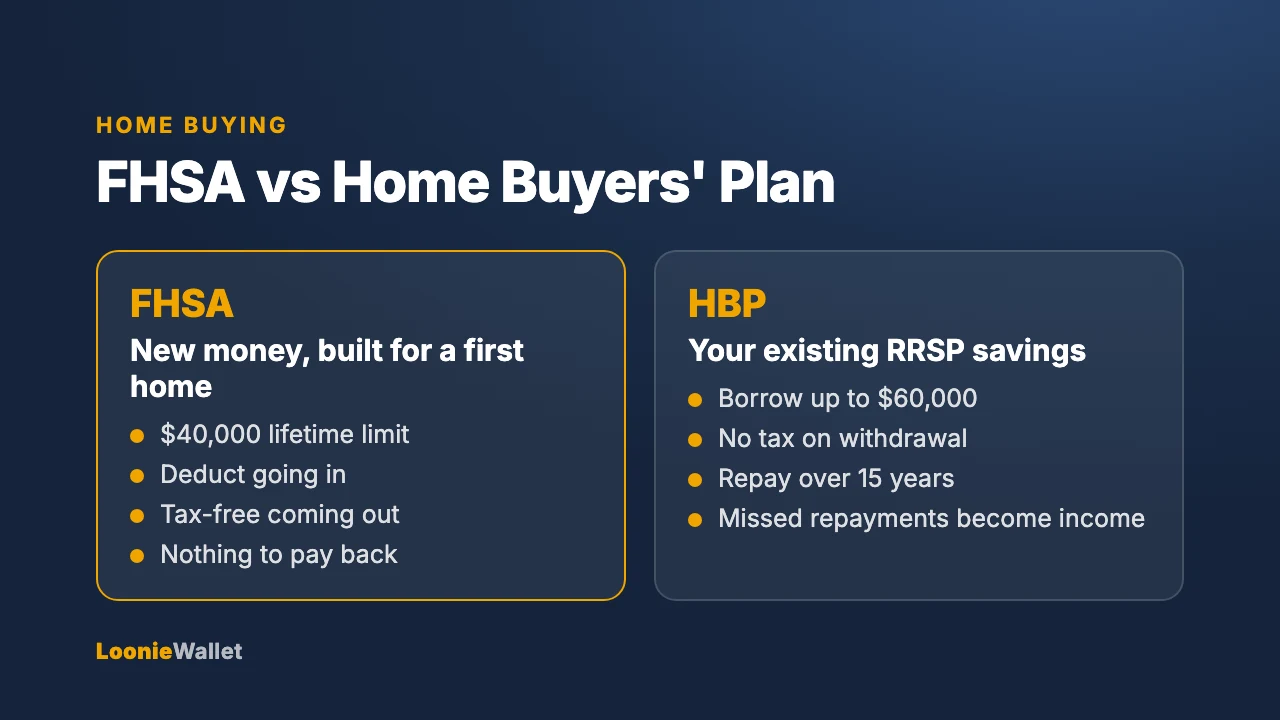
The First Home Savings Account and the RRSP Home Buyers’ Plan look alike on the way in and on the way out: a deduction when you contribute, no tax when you withdraw for a first home. The difference is what happens afterwards. FHSA money is yours. HBP money is a loan from your own retirement savings that you repay over 15 years, and if you miss a repayment the CRA adds it to your income.
That makes the ranking simple: FHSA first, HBP second, and both together if you need more than $40,000. The CRA confirms you can make an HBP withdrawal and an FHSA qualifying withdrawal for the same home, as long as you meet each program’s conditions at the time of each withdrawal.
Side by side
| Feature | FHSA | RRSP Home Buyers' Plan |
|---|---|---|
| Deduction on contribution | Yes, $8,000 a year | Yes, up to your RRSP room ($33,810 max new room in 2026) |
| Maximum for the home | $40,000 of contributions plus all growth, no cap on the withdrawal | $60,000 per person |
| Repayment | None | 1/15 per year over 15 years; shortfalls are added to income |
| Repayment start | n/a | Second year after withdrawal; fifth year for withdrawals made 2022 through 2028 |
| Withdrawal form | RC725 to your issuer | T1036 to your issuer, one per withdrawal |
| Recent contributions | No waiting period | Contributions in the 89 days before the withdrawal may not be deductible |
| Timing of withdrawals | Before or up to 30 days after acquiring the home; close the account by Dec 31 of the following year | All withdrawals in the same calendar year as the first, or January of the next |
| If you never buy | Roll into an RRSP tax-free; no room used | Money stays in the RRSP |
| Room after use | Gone (account closes) | Repayments do not create new room; they refill the old |
Verified against CRA on 2026-09-18.
Conditions both programs share
The two programs were built on the same definitions, so you either qualify for both or neither on most points:
- First-time home buyer, tested at withdrawal. You did not live in a home you owned as your principal residence at any time this calendar year before the withdrawal (except the 30 days immediately before) or in the previous four calendar years. The same test applies to a home your spouse or common-law partner owned while you lived there.
- A written agreement to buy or build at the time of withdrawal. The CRA is explicit that a mortgage pre-approval does not count.
- Resident of Canada at withdrawal.
- Intend to occupy the home as your principal residence within one year of buying or building it.
- Acquire or build the home before October 1 of the year after your first withdrawal.
Where they differ in practice
The 89-day rule. RRSP contributions made in the 89 days before an HBP withdrawal are deductible only to the extent the RRSP still holds at least that much afterwards. In plain terms, you cannot contribute $20,000 in March, deduct it, and take it out under the HBP in April. Plan HBP contributions at least three months ahead of the withdrawal. The FHSA has no such rule; you can contribute in January and make a qualifying withdrawal in February.
Withdrawal windows. HBP withdrawals must all fall in one calendar year, or that year plus the following January. FHSA withdrawals can be spread out, but the first one starts the clock on closing every FHSA by December 31 of the following year, and you cannot take an FHSA qualifying withdrawal more than 30 days after you acquire the home.
The repayment. An HBP withdrawal of $60,000 made in 2026 falls under the temporary deferral, so the first repayment is due for the 2031 tax year and the schedule runs to 2045 at $4,000 a year. Each repayment is an RRSP contribution you designate on Schedule 7 rather than deduct. If you contribute less than the minimum in a year, the shortfall is added to your income for that year and taxed. Over 15 years that is a real cash-flow commitment on top of a new mortgage, which is why the FHSA, with no repayment at all, ranks first.
What the money can become. FHSA withdrawals have no cap: $40,000 of contributions that grew to $55,000 comes out as $55,000. HBP is capped at $60,000 regardless of how large the RRSP is.
Stacking both
Per person: $40,000 of FHSA contributions plus growth, plus up to $60,000 from the RRSP. A couple who both qualify can combine two FHSAs with $120,000 of HBP withdrawals, which is why “$200,000-plus tax-advantaged down payment” appears in so many articles. The figure is right; the assumptions behind it (two people, each with a full FHSA and at least $60,000 in an RRSP) are rarer than the articles imply.
The order of operations when you can only fund one thing at a time:
- Max the FHSA every year. Its deduction is worth the same as an RRSP deduction and it never has to be repaid.
- Put the tax reduction from the FHSA into the RRSP if you plan to use the HBP, or into a TFSA if you do not.
- Fund the RRSP for the HBP only with money you can afford to repay over 15 years, and get it in at least 89 days before you will need it.
- Use a TFSA for anything above those limits.
Transferring RRSP money into an FHSA instead of using the HBP
You can transfer RRSP savings directly into an FHSA up to your FHSA room. The transfer earns no second deduction and does not restore the RRSP room it came from, but the money then comes out for the home with no repayment obligation. For someone with RRSP savings, unused FHSA room, and a purchase two or more years away, this converts a loan into a gift. For a purchase this year, the HBP’s higher cap usually matters more.
Which one, in one sentence each
- You have no RRSP savings: FHSA only. Do not open an RRSP just to run money through the HBP.
- You have RRSP savings and years before buying: FHSA first, transfer up to your FHSA room from the RRSP, HBP on whatever remains.
- You have RRSP savings and are buying this year: FHSA up to this year’s room, HBP for the rest, contributions in the RRSP at least 89 days out.
- You are not a first-time buyer: neither. Use the TFSA.
Full rules for the FHSA are in the FHSA guide; the HBP is covered in the RRSP guide. The combined plan with worked examples is in the down-payment strategy.
This article is for education, not tax advice. Confirm your eligibility and room with the CRA and consult a tax professional before withdrawing. Limits, rates and rules on this page are as of the time of writing and can change without notice; confirm current figures with the CRA before you act.
About LoonieWallet
LoonieWallet is an independent resource created to help make smarter financial decisions. We research and publish fact-based guides, tutorials, and product reviews covering money transfers, fintech apps, and personal finance tools. Our mission is to make personal finance easier and clearer so readers can save time, money, and stress.
Read more about us here. If you have any questions, you can contact us using this page.
Sources
Checked on Sep 18, 2026 (CRA HBP limit, conditions, 89-day rule and repayment deferral; FHSA qualifying-withdrawal conditions; CRA statement that both can be used for the same home).
- How to participate in the Home Buyers' Plan — Canada Revenue Agency
- How to repay the amounts withdrawn from your RRSPs under the Home Buyers' Plan — Canada Revenue Agency
- What is the Home Buyers' Plan (HBP)? — Canada Revenue Agency
- Withdrawals from your FHSAs — Canada Revenue Agency
- Withdrawals and transfers out of your FHSAs — Canada Revenue Agency