LoonieWallet Team · Investment · Last verified
FHSA + RRSP + TFSA: A Down-Payment Strategy With Worked Examples
The order to fill the three accounts, a calendar of the deadlines that trip people up, and two worked examples: a single buyer with five years and a couple buying in eighteen months. Then a check against the minimum down payment and the insured cap.
Three registered accounts can fund a first-home down payment. Used in the right order they add tax deductions and tax-free growth to every dollar you save; used in the wrong order they leave deductions unclaimed, trigger the 89-day rule, or miss a filing deadline. This guide gives the order, the calendar, and two worked examples, then checks the result against what a lender will accept.
The order of operations
- Open an FHSA now, even with nothing in it. Room accrues only from the year you open it, $8,000 a year to a $40,000 lifetime limit, and unused room carries forward only one year’s worth.
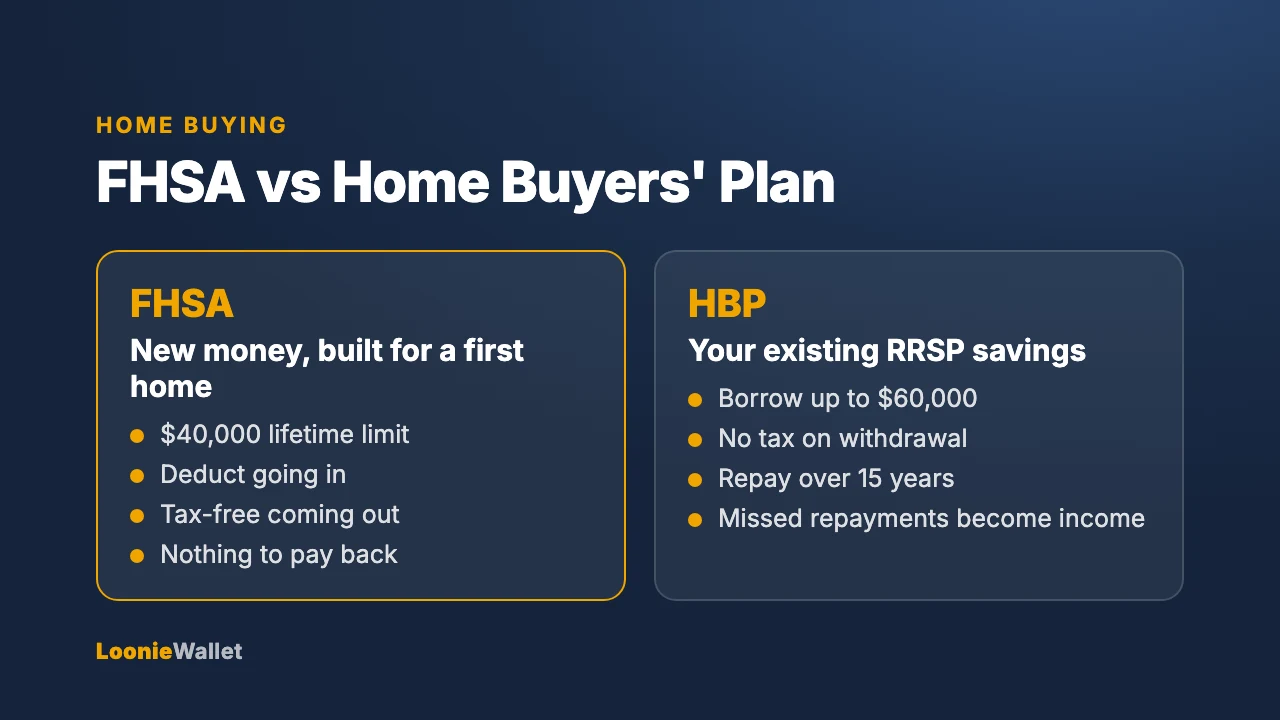
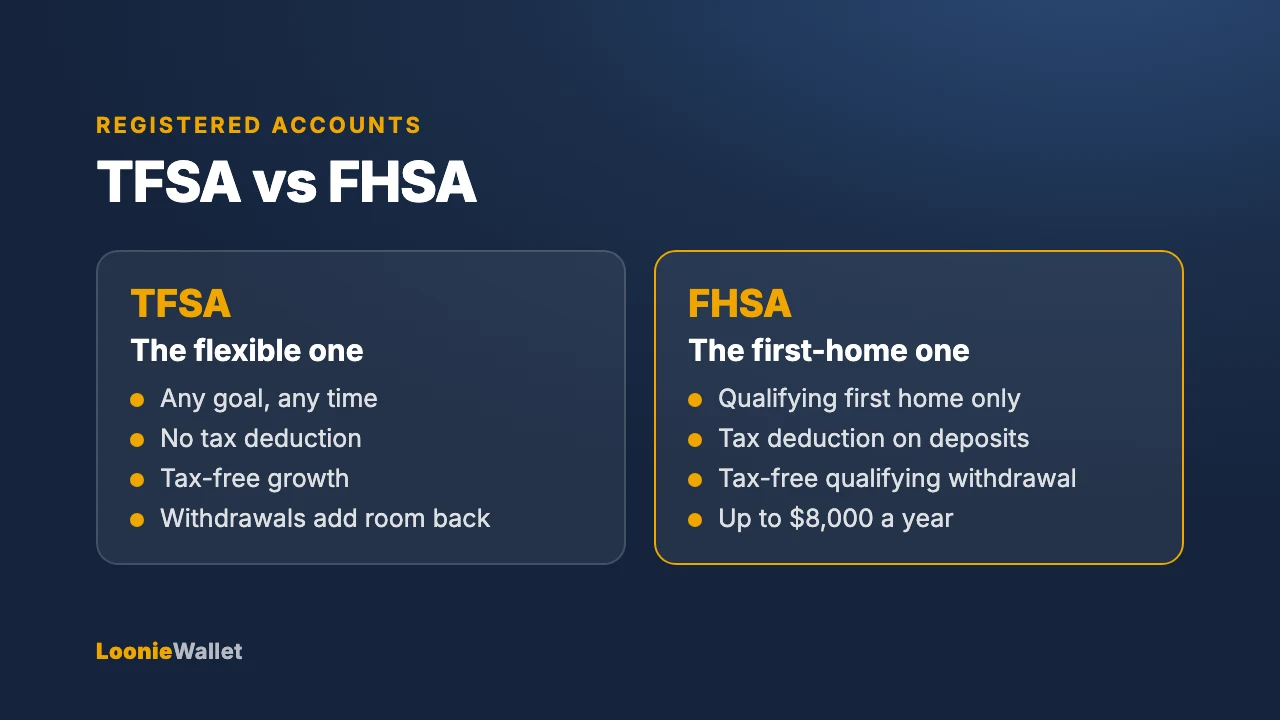
- Fill the FHSA first, every year, up to its room. It gives an RRSP-style deduction and a TFSA-style tax-free withdrawal, and nothing has to be repaid. If you have home savings sitting in a TFSA, move $8,000 a year across; the TFSA room comes back the next January.
- Reinvest the deduction. An $8,000 contribution at a 30% marginal rate lowers your tax by about $2,400. That money goes into the RRSP if you will use the Home Buyers’ Plan, otherwise into the TFSA.
- Use the RRSP for the Home Buyers’ Plan if you already have RRSP savings, an employer match, or income above the FHSA’s room. You can withdraw up to $60,000 and must repay it over 15 years, starting in the fifth year after withdrawal for withdrawals made 2022 through 2028. Contributions must be in the RRSP at least 89 days before you withdraw them.
- The TFSA takes everything else: savings above the FHSA and HBP limits, and any part of the plan you are not sure about. It is the only one of the three with no strings.
The CRA allows an FHSA qualifying withdrawal and an HBP withdrawal for the same home, provided you meet each program’s conditions at the time of each withdrawal.
The calendar that decides whether it works
| When | What must be true |
|---|---|
| Any time before buying | You are a first-time buyer under the CRA test: no home you owned as a principal residence this year (except the 30 days before withdrawal) or the previous four calendar years, including a spouse’s or partner’s home you lived in. |
| At least 89 days before an HBP withdrawal | RRSP contributions you want to deduct are already in the account. |
| Before either withdrawal | You have a signed agreement of purchase and sale, or a building contract. A pre-approval is not an agreement. |
| HBP withdrawals | All in one calendar year, or that year and the following January. Form T1036 for each. |
| FHSA withdrawal | Form RC725; no later than 30 days after you acquire the home. |
| Closing date | Before October 1 of the year after your first withdrawal (both programs). |
| Within one year of closing | You occupy the home as your principal residence. |
| December 31 of the year after your first FHSA qualifying withdrawal | Every FHSA you hold is closed. Leftovers roll to an RRSP tax-free or are withdrawn as income. |
| The fifth year after an HBP withdrawal (2022–2028 withdrawals) | First HBP repayment is due: 1/15 of the amount, designated on Schedule 7. |
Worked example 1: one buyer, five years out
Maya earns $85,000 in Ontario, has $12,000 in a TFSA, no RRSP, and wants to buy in five years. Her combined marginal rate is about 30%.
Years 1 to 5: she contributes $8,000 a year to a new FHSA from cash flow and leaves her existing $12,000 in the TFSA. Each FHSA contribution reduces her tax by roughly $2,400, which she puts into the TFSA. She saves another $300 a month into the TFSA on top.
At a 5% return, after five years she has:
| Account | Balance | Notes |
|---|---|---|
| FHSA | about $44,200 | $40,000 contributed, all withdrawable tax-free |
| TFSA | about $48,500 | The original $12,000, five reinvested deductions of $2,400, and $300 a month, all grown |
| Total | about $92,700 | No repayment obligations |
Had she put the same $8,000 a year into the TFSA instead, she would have about $79,400. The difference, about $13,300, is the five deductions and their growth.
At purchase: she signs an agreement in April of year 6, makes an RC725 qualifying withdrawal of the full FHSA balance, withdraws what she needs from the TFSA, and closes the FHSA by December 31 of year 7. Because she has no RRSP, the HBP does not enter into it.
Worked example 2: a couple, eighteen months out
Sam and Priya earn $95,000 and $70,000 in British Columbia. Sam has $70,000 in an RRSP from an employer plan; Priya has $20,000 in an RRSP and $25,000 in a TFSA. Neither has an FHSA. They plan to buy in about eighteen months.
Now: both open FHSAs. Sam contributes $8,000 from cash flow; Priya moves $8,000 from her TFSA. Both deduct it. Sam would like to transfer RRSP money into his FHSA as well, but this year’s $8,000 of room is already used, so the transfer waits for January. Room is $8,000 per person per year whether it comes from cash or from an RRSP.
Next January: each has another $8,000 of room. Sam transfers $8,000 from his RRSP into the FHSA (no new deduction, no repayment later). Priya contributes $8,000 from cash and deducts it. Priya also contributes $6,000 to her RRSP now, so it is in place more than 89 days before any HBP withdrawal, and deducts that.
Eighteen months in, agreement signed:
| Source | Sam | Priya | Notes |
|---|---|---|---|
| FHSA qualifying withdrawal | about $16,800 | about $16,800 | Two years of contributions plus growth, tax-free, no repayment |
| HBP withdrawal | $60,000 | $26,000 | Sam takes the maximum from his $62,000 remaining RRSP; Priya takes her full RRSP |
| TFSA | 0 | $17,000 | Priya’s remaining TFSA |
| Total | about $137,000 | Plus the tax reductions on $30,000 of deductible contributions, available for closing costs |
Afterwards: both close their FHSAs by December 31 of the year after the withdrawal. Sam’s HBP repayment of $4,000 a year and Priya’s of about $1,733 a year begin in the fifth year after the withdrawal (2031 for a 2026 withdrawal) and run for 15 years. If they had waited two more years, each could have added $8,000 a year to the FHSAs and reduced the HBP amounts they now have to repay.
Now check it against the mortgage rules
A down payment is not a number in isolation. Three rules decide what it buys.
Minimum down payment. 5% of the first $500,000 of the price and 10% of the portion above that, for homes under $1,500,000. At $1,500,000 or more, 20%. Maya’s $92,700 clears the minimum on a home up to about $1,177,000 ($25,000 plus 10% of $677,000). Sam and Priya’s $137,000 clears it on anything under the $1,500,000 cap, where the minimum jumps to 20%.
Insured or not. Below 20% down the mortgage is insured and the premium is added to the loan: 4.00% of the mortgage at 5% to 9.99% down, 3.10% at 10% to 14.99%, 2.80% at 15% to 19.99%, plus 0.20% if the amortization runs past 25 years. On a $700,000 home with $92,700 down (13.2%), the premium is 3.10% of the $607,300 mortgage, roughly $18,800, added to the loan. Reaching 20% ($140,000) avoids it entirely. Whether to wait and save the extra, or buy now and pay the premium, is a judgment about the market you are in, not a tax question.
What you qualify for. The down payment sets the ceiling on price; income sets the ceiling on the mortgage. Lenders test the mortgage at the greater of your rate plus 2% or 5.25%, with housing costs capped at 39% of gross income and all debts at 44%. First-time buyers can take a 30-year insured amortization on any home, and anyone can on a new build. Run your own numbers in the affordability calculator before you decide how much down payment you actually need.
Mistakes this plan avoids
- Contributing to the RRSP the month before an HBP withdrawal and losing the deduction to the 89-day rule.
- Leaving home savings in a TFSA when they could earn a deduction in an FHSA at no cost in room.
- Taking the HBP first and the FHSA second, and carrying a 15-year repayment on money that could have come out free.
- Missing the October 1 acquisition deadline with a late-year withdrawal.
- Forgetting to close the FHSA the year after buying, which turns the leftover balance into income.
Detailed rules: FHSA guide, FHSA vs TFSA, FHSA vs Home Buyers’ Plan, RRSP guide, TFSA guide.
This article is for education, not tax or mortgage advice. The examples use round assumptions and simplified tax rates; your room, rates, and lender rules will differ. Confirm eligibility with the CRA and get mortgage advice from a licensed professional. Limits, rates and rules on this page are as of the time of writing and can change without notice; confirm current figures with the CRA before you act.
About LoonieWallet
LoonieWallet is an independent resource created to help make smarter financial decisions. We research and publish fact-based guides, tutorials, and product reviews covering money transfers, fintech apps, and personal finance tools. Our mission is to make personal finance easier and clearer so readers can save time, money, and stress.
Read more about us here. If you have any questions, you can contact us using this page.
Sources
Checked on Sep 18, 2026 (CRA FHSA, HBP and TFSA limits and withdrawal conditions; FCAC minimum down payment; Finance Canada insured cap and 30-year amortization eligibility; CMHC premiums).
- First Home Savings Account (FHSA) — Canada Revenue Agency
- How to participate in the Home Buyers' Plan — Canada Revenue Agency
- How to repay the amounts withdrawn under the Home Buyers' Plan — Canada Revenue Agency
- Down payment — Financial Consumer Agency of Canada
- Boldest mortgage reforms in decades come into force today (December 15, 2024) — Department of Finance Canada
- Premium information for homeowner loans — Canada Mortgage and Housing Corporation